
Pain is private. The only version of it your doctor ever gets is the version you put into words, so the words are worth choosing in advance.
This guide is general information about describing and tracking pain, not medical advice. Talk to your clinician about your own care.
There is a specific frustration in leaving an appointment feeling like nothing landed. Usually it is not that you were unclear. It is that pain has almost no natural vocabulary, so most of us reach for intensity words, bad, terrible, unbearable, and intensity is the one dimension a clinician can do the least with. The description that moves a visit forward has four parts: what the pain feels like, how much of it there is, where and when, and what it costs you.
1. Quality: what it feels like
This is the part people skip and one clinicians often ask about, because the character of pain hints at what kind of pain it is. Pick the words that fit, and it is fine to use more than one:
- Burning, raw, scalding. Often used for nerve-related pain.
- Shooting, shock-like, electric, radiating. Pain that travels along a line.
- Pins and needles, tingling, numb. Altered sensation rather than pure pain.
- Aching, dull, deep, heavy. Often used for muscle and joint pain.
- Throbbing, pounding, pulsing. Pain that moves with your heartbeat.
- Stabbing, sharp, knife-like. Sudden and focal.
- Cramping, gnawing, squeezing, tight. Often used for deeper or internal pain.
- Tender to touch. When contact itself hurts, say so, it is a separate observation.
Two words beat one adjective repeated three times. "Burning across my lower back with shooting pain down the left leg" tells a clinician more than "the pain is a nine".
2. Intensity: make the 0-10 scale carry information
The scale is only useful when it is anchored, because your seven and someone else's seven are not the same thing. (Paper sheets usually run 0 to 10; Pain Journal records 1 to 10, because a pain-free day is simply not logged.) Two habits fix it.
Give three numbers, not one. Your best, your average and your worst over the period. "Best day a three, most days a six, worst two days a nine" describes a life. A single number describes a moment, usually the moment you are sitting in the waiting room.
Tie each number to a behaviour. "At a four I can work but not exercise. At a seven I stop answering messages. At a nine I cannot stand up straight." Now the number is not a feeling, it is a threshold, and thresholds are something a clinician can work with.
3. Location and timing
Point rather than describe, if you can. Widespread or moving pain is far clearer on a body map than in sentences, and it stops the "and where exactly?" loop that eats half the appointment. Then add the shape of it over time: is it constant with flares on top, or completely absent between episodes? Does it wake you at night, build through the day, or hit on standing? How long does an episode last, minutes, hours, days? Which movements or positions reliably set it off, and which relieve it? "Worse sitting, better walking" is a genuine clinical clue and takes three words.
4. Function: what the pain costs you
Function is often the part clinicians act on and the part patients most often leave out. Say what you have stopped doing and when you stopped. "I have not slept more than four hours since May." "I gave up driving in March." "I can no longer lift my daughter." These sentences are concrete, dated and impossible to reinterpret as minor, and they belong near the start of the conversation, not the end.
The sentence that opens the appointment
Put the four parts into one line and lead with it, before the story: "Over the last six weeks the pain has been burning across my lower back with shooting pain down my left leg, averaging a six with two days at a nine, worse sitting and better walking, and it has stopped me sleeping through the night." That is quality, intensity, location, timing and function in a single breath. Everything else you brought is detail for when they ask.
Do not describe it from memory
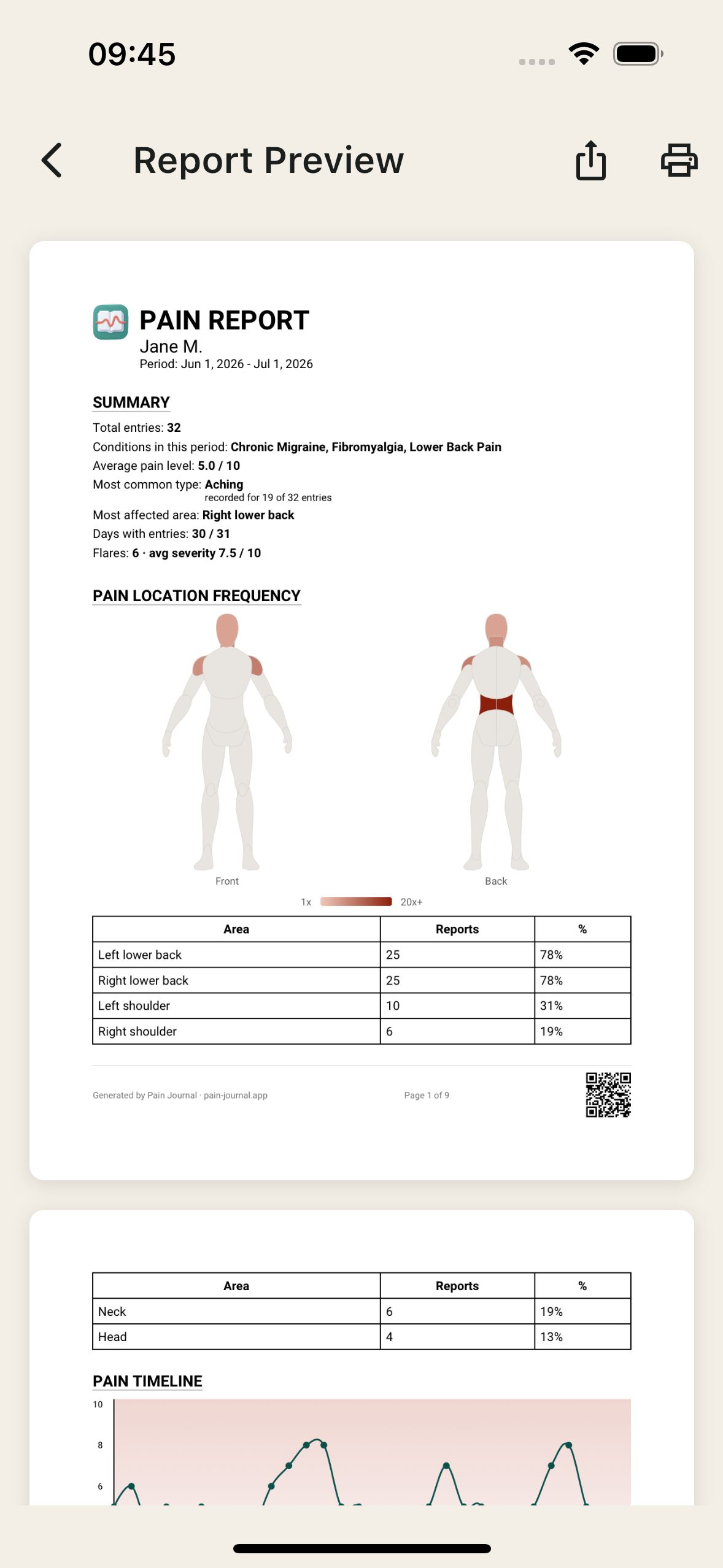
This is the quiet failure behind most of the descriptions above. By the appointment, weeks have blurred, the good days have been forgotten, and people tend to understate. A dated record, written as things happened, removes the guesswork entirely: you are no longer recalling, you are reading. It also means you are not composing a careful description while in pain and on the clock.
Start today
You can do all of this on paper with our free printable pain diary, which already lays out the body map, the 0-10 scales and the descriptor list. When filling it in by hand gets tedious, Pain Journal logs the same things in a few taps and builds the summary for you, free for the last 7 days, with no account.
Next: what to tell your doctor about chronic pain, the five things to bring, or how to prove your pain when you feel dismissed.
Common questions
What words should I use to describe pain to a doctor?
Use quality words rather than intensity words: burning, stabbing, aching, throbbing, shooting, electric,
gnawing, cramping, tight, raw, pins and needles, numb. Quality points at mechanism, so it carries more
information than saying the pain is bad.
How do I explain my pain level on a 0 to 10 scale?
A single number means little on its own. Anchor it to something concrete: say what a number stops you
doing, and give three numbers rather than one, your best, average and worst over the period.
Why does my doctor not seem to understand how bad my pain is?
Descriptions given from memory in the room tend to compress weeks into how you feel that morning, and often understate. A dated record of the whole period removes the guesswork, because it shows the pattern
rather than a single moment.
Should I write my pain description down before the appointment?
Yes. Writing it down beforehand means you are not composing a description while in pain and under time
pressure, and it lets you hand over a page instead of recalling out loud.