
A pain management appointment is short, and most of it is spent reconstructing the last few months out loud. That is the part you can do in advance, on paper, when you are not under pressure.
This guide is general information about preparing for appointments, not medical advice. Talk to your clinician about your own care.
What a pain appointment actually asks for
The questions are fairly predictable, whichever clinic you go to. Where the pain is and what it feels like. How severe it gets at its worst, and what a typical day looks like. How long it has gone on and whether anything has changed. What makes it better or worse. How it affects sleep, work, and getting through the day. What you are taking, what you have already tried, and what happened with each.
Almost all of that is history rather than examination, and history is the one part of the visit that depends entirely on what you can recall in the room. Recall is exactly what pain, poor sleep and a waiting-room clock are worst for.
The six things worth writing down first
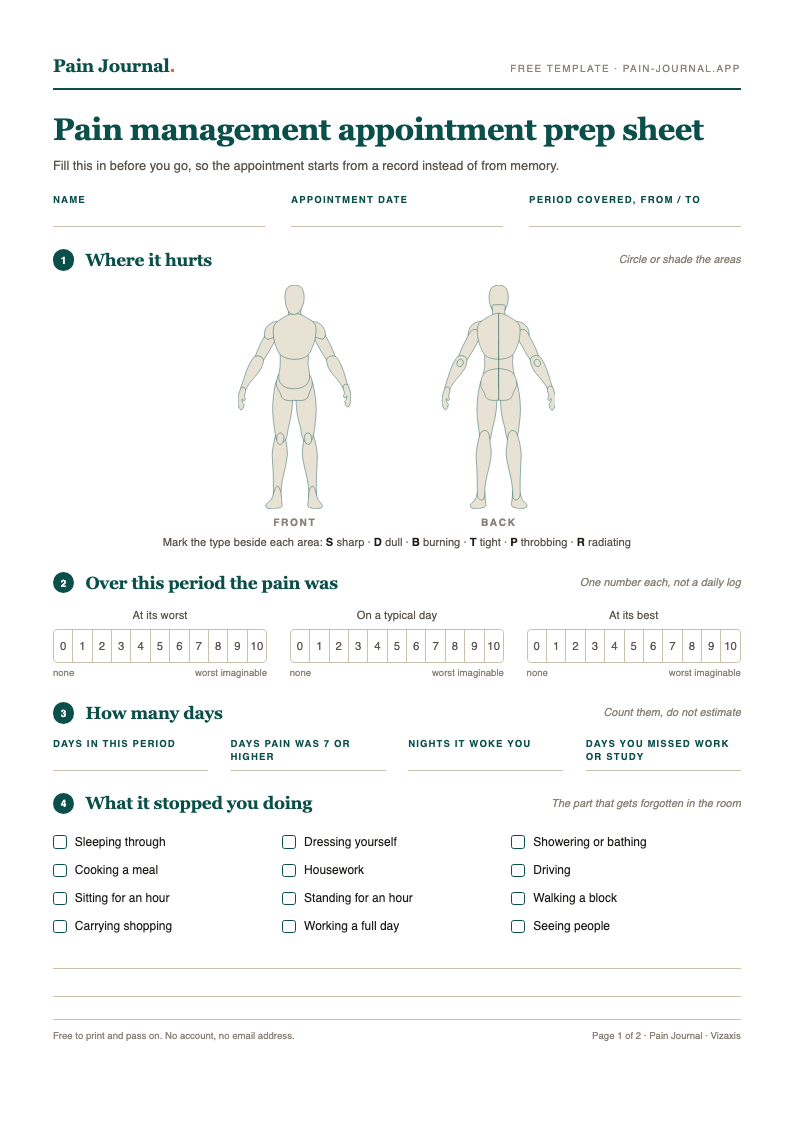
- Where, and what kind. Shade a body map rather than describing locations in words, and mark the character beside each area: sharp, dull, burning, tight, throbbing, radiating.
- Three numbers, not a daily diary. Your pain at its worst, on a typical day, and at its best over the period. Clinicians usually want that summary before anything else.
- Counts, not adjectives. How many days in the period, how many were 7 or above, how many nights it woke you, how many days you missed work or study. "Most days" is an impression; "eleven of the last thirty" is a finding.
- What it stopped you doing. Function loss is the part patients most often leave out and clinicians most often need: dressing, showering, cooking, driving, sitting or standing for an hour, carrying shopping, working a full day.
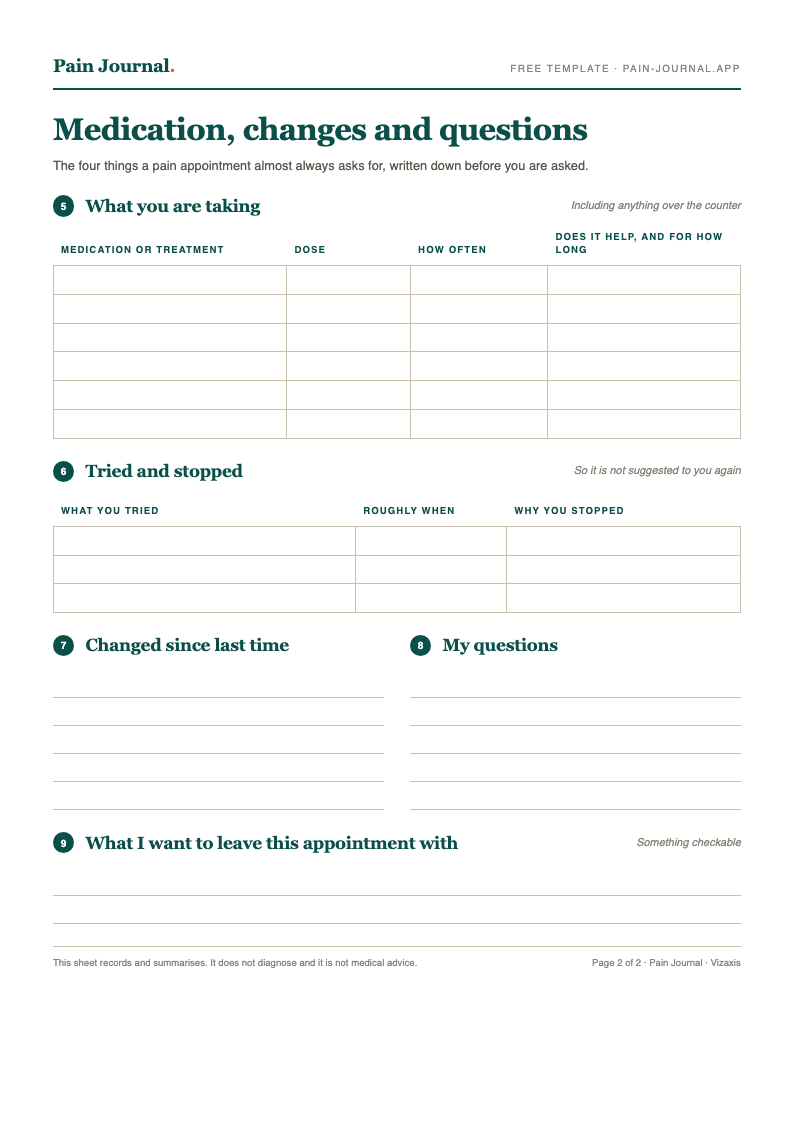
- Medication, honestly. Everything you take, including over the counter, the dose, how often, whether it helps and for how long.
- Tried and stopped. What you have already been through and why it ended, so the appointment does not spend its time re-suggesting it.
How to use the prep sheet
Print it when you book the appointment and leave it somewhere you will see it. You do not need to fill it in daily. Add a line on the worse days, and complete the summary boxes the evening before you go. A week or two of notes is plenty; the aim is that your numbers are counted rather than guessed.
On the day, page one is the two-minute version: body map, three severity numbers, the day counts, and the function checklist. Page two is what you hand over or read from when the conversation turns to treatment.
Why this changes how the appointment goes
A written record survives a good day. If you happen to arrive on one of your better days, the sheet still carries the bad weeks with it, and the visit is not decided by how you look in that ten minutes. It also shortens the history-taking, which leaves more of a short appointment for what to do next. None of this is about performing your pain. It is about making sure the full picture is actually in the room.
Bringing questions of your own
Write down what you want to leave with, and make it checkable: a referral, a specific test, a plan for what to do during a flare, a follow-up date, a decision about a medication you are unsure of. Vague appointments tend to end vaguely. The last box on the sheet exists for exactly this.
If you would rather not fill it in by hand
The paper sheet works fine, but redoing it before every visit gets tedious. That is why we built Pain Journal: it captures the same things in a few taps a day and generates the summary as a PDF for you, body-map heatmap included. The doctor report is free, covering the last 7 days, with no credits and no per-export fee. Either way the goal is the same, which is never drawing a blank when you are asked how it has been.
Common questions
How should I prepare for a pain management appointment?
Bring it written down rather than recalled: where it hurts, worst / typical / best on a 0-10 scale, how
many days were bad, what the pain stopped you doing, what you take and whether it helps, what you have
already tried and stopped, and the questions you want answered.
What will they ask at a first pain management appointment?
Mostly history: location and character, severity, duration, what helps or worsens it, the effect on
sleep, work and daily tasks, and every treatment you have tried with what happened. Writing it in
advance is what saves the time.
How far back should the record go?
A week or two is enough to be useful. It is not an archive, it is a handful of dated entries so the
summary you give is counted instead of estimated.
Is the prep sheet free?
Yes, a two-page A4 PDF, no email address, no account, no sign-up. The app is free too and builds the
same summary automatically, with free doctor reports covering the last 7 days.