
Appointments about pelvic pain tend to turn on one question, asked in some form or another: how does this sit against your cycle. It is a reasonable question and it is almost impossible to answer honestly from memory, because the thing being asked about happens over months and you are being asked in a ten minute window.
This guide is general information about tracking symptoms and preparing for appointments, not medical advice. It does not tell you what your symptoms mean, whether you have any particular condition, or what to do about them. Talk to your doctor about your own care.
What tends to come out instead is a summary: it is bad around my period, it has got worse, some months are fine. Every part of that may be true, and none of it can be checked, compared, or brought back to at the next visit. A dated record replaces the summary with the underlying days, and it does that without asking you to interpret a single thing.
1. Put the pain and the cycle on the same calendar
This is the one that does the work. Record pain by date, and record your period start and end dates in the same place, so the two can be read against each other rather than recalled separately.
The reason is simple. "Worse around my period" is an impression. A month showing pain on the four days before bleeding started, nothing for a week, then two more days mid-cycle, is the same statement with the evidence attached, and it is the version that survives being asked "how sure are you?". You do not have to know what the pattern means. You only have to make sure it still exists by the time you are sitting in the chair.
2. Where it sits, specifically
Pelvic pain is not one place. Lower abdomen, one side or both, deeper or nearer the surface, lower back, down a leg, around the rectum or bladder. Mark the location each time rather than writing "pelvic pain" every entry, because the distribution over two months is information and the phrase is not.
Keep sides separate. Left and right are different entries, and if it turns out that nine of eleven bad days were the same side, that is something you would never have reconstructed afterwards.
3. The days that are not period days
Pain outside your period is often under-reported, partly because it does not fit the story you have been telling yourself and partly because it is easy to write off as a normal bad day. Record it with the same weight. Pain at ovulation, pain during or after sex, pain with bowel movements or urination, pain that has no relationship to the calendar at all.
These entries are often the ones that add most to an appointment, and they are exactly the ones that get left out of a verbal summary because the conversation has already been framed around periods. Write them plainly, in your own words, with the date. You are recording that it happened, not arguing for what it signifies.
4. How long it lasted, and how bad at its worst
Duration is the number people skip and clinicians use. An hour is a different entry from all day, and a day is different from four days that ran together. Note when it started and roughly when it eased.
For severity, one number per day is enough (0 to 10 on paper, 1 to 10 in the app), taken at the worst point of that day rather than averaged in retrospect. Consistency matters more than precision here. A scale you apply the same way every day is readable across two months even if your personal 7 is somebody else's 5.
5. What it cost you
Function is the part patients leave out and clinicians act on. Work missed or worked through at half capacity, a class or a shift you could not finish, a day spent on a heating pad, plans cancelled, the morning you could not stand up straight.
Attach it to the date and keep it to one line. Eleven painful days read very differently when five of them cost a working day, and you will not remember which five. This is also the part that is usually asked for if the record is ever needed for work, school, or an insurance form later.
6. What you tried, as dates rather than verdicts
Note what you took or did and when, including anything over the counter, prescribed medication, heat, appointments, scans, and anything a previous clinician suggested. Include the dates you started and stopped.
Do not grade whether it worked. Judging effectiveness over weeks, while you are in the middle of it, is genuinely hard, and a record full of your own verdicts is harder for someone else to read than one full of facts. Whether a thing helped is the conversation you are going to the appointment to have. Your part is that the dates are accurate.
Bring the record, not the conclusion
A lot of people arrive having read for months and having reached an answer, sometimes the right one. It is still worth leading with the history rather than the theory. Diagnosis here involves examination and imaging, and sometimes surgery, and none of that gets settled in a notebook. The dated record of what your pain actually did is the thing they cannot get any other way, it is genuinely yours to bring, and it stays useful regardless of what the eventual answer turns out to be.
Bring one page
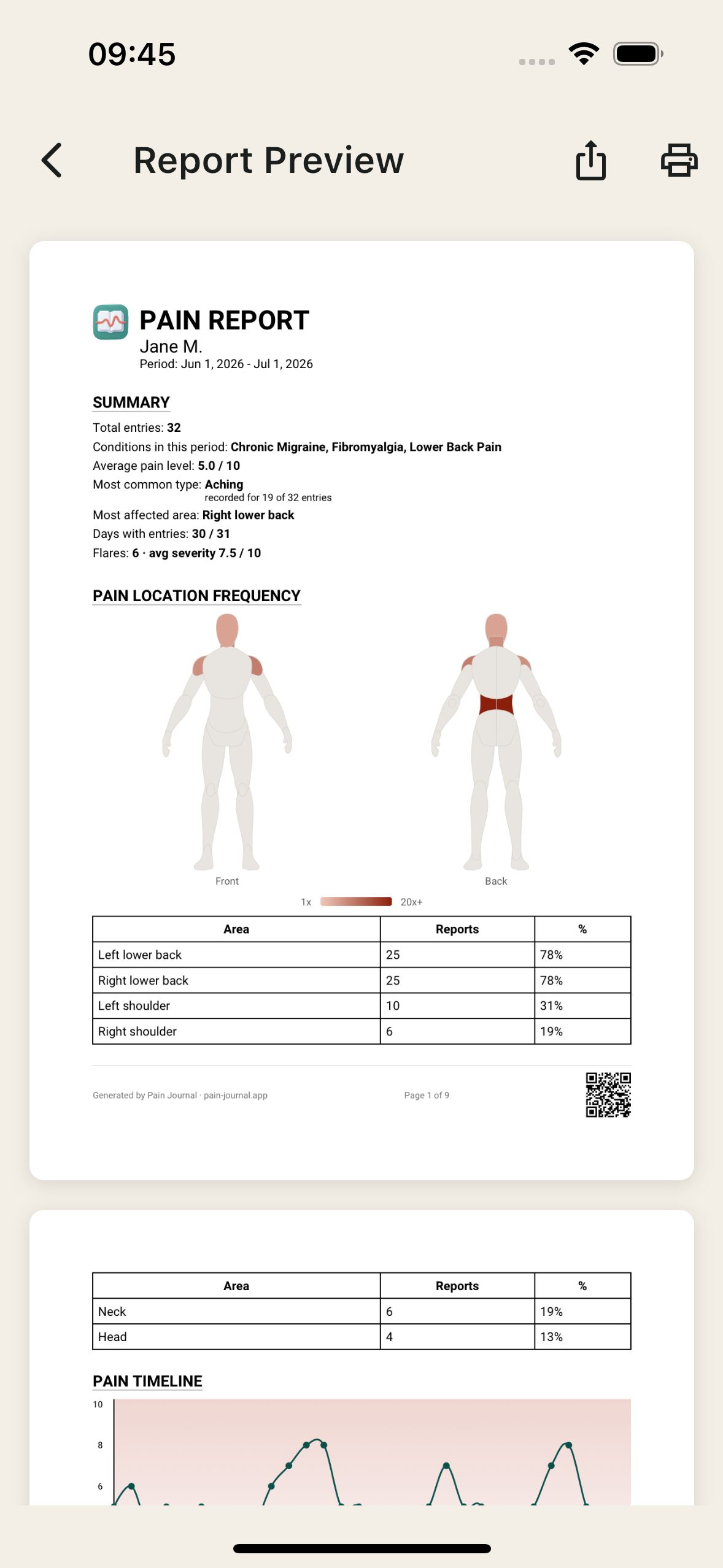
Nobody is reading three months of daily entries in a short appointment, and a thick notebook usually gets politely set aside. What works is a single summary page: how many pain days against the total, where they sat relative to your cycle, the locations that came up most, the worst-day scores, and the days you lost. The detail stays underneath for when they ask.
How often to log
Once a day, in seconds, quiet days included. Marking the days that were fine is what gives you a denominator, and without one you have a pile of bad days and no idea what share of the month they were.
The failure mode is not a missed entry. It is designing an elaborate daily form in week one and abandoning it by week three, which leaves you back at remembering, now with the added irritation of having tried. A record is a sample, not an exam.
Start today
You can do all of this on paper with our free printable pain diary, which already has the 0-10 scales and the body map laid out, so the locations are a mark rather than a sentence. When the daily writing gets tedious, Pain Journal records the same things in a few taps and builds the summary for you, free for the last 7 days, with no account.
Next: how to describe your pain to a doctor, or what to bring to the appointment.
Common questions
What should I track for endometriosis before a gynecology appointment?
Pain by date and location, your period start and end dates on the same calendar so the two can be read
together, the pain days that fall outside your period, how long each episode lasted, what it stopped you
doing that day, and what you took or tried with the dates. Record it as plain observation without deciding
what it means.
Why does the timing of the pain matter so much?
Because the relationship between your pain and your cycle is a pattern, and a pattern only exists if both
are dated on the same record. Saying the pain is worse around your period is an impression. A calendar
showing which days hurt and which days you were bleeding is the same claim with the evidence attached, and
it is the part that memory loses first.
Should I write down that I think I have endometriosis?
Bring the record rather than the conclusion. Diagnosis involves examination and imaging, and sometimes
surgery, and none of that is something you can settle in a notebook. A dated history of what your pain
actually did is the thing a clinician cannot get any other way, and it stays useful no matter what the
eventual answer turns out to be.
How long should I track before the appointment?
Ideally across at least one full cycle, and preferably two or three, because a single month cannot show a
pattern that repeats. If the appointment is sooner than that, start anyway. Three weeks of one-line daily
entries is still far better than reconstructing the year in the waiting room.