
You cannot prove the sensation of pain to anyone. But you can document it, and a documented pattern is much harder to wave off than a description from memory.
This guide is general information about tracking pain and preparing for appointments, not medical advice. If you feel your care is not right for you, talk to your clinician or seek a second opinion.
Chronic pain has no blood test and no scan that reads out a number, so it lives or dies on how it is described. When someone arrives at an appointment and describes only how they feel that morning, the whole condition can end up sounding like one average day. A single appointment gives a clinician one moment to go on, and one moment usually looks milder than the months behind it. That gap, between the snapshot and the pattern, is where "let us keep an eye on it" comes from. Closing it is not about proving you are in pain. It is about bringing evidence that the pain is real, frequent, and getting in the way.
What "proof" actually means for pain
There is no way to measure the ache itself. What you can measure is everything around it, and those numbers are what a doctor can act on:
- Consistency over time. The same zones, the same kind of pain, showing up across weeks of entries reads as a real pattern, not a one-off bad day.
- Frequency and duration. "Fourteen flare days last month, most lasting past the afternoon" is a fact on a page. "It is bad a lot" is not.
- Functional loss. What you stopped being able to do is objective and checkable in a way a pain score never is: missed workdays, the walk you cut short, the stairs you now avoid.
- Timing you did not choose. A record kept in the moment, before you knew how the week would turn out, cannot be accused of being remembered to sound worse.
Five moves that turn "I am in pain" into a record
None of these require a diagnosis or a single dollar. They just change pain from a story into data.
- Log in the moment, not from memory. Recall in a waiting room almost always undersells the period. A note made the hour it happened does not.
- Capture the range, not today. Your worst, average, and best over the last few weeks. The spread is the story a single number hides.
- Write down what it stops you doing. Function is the most objective thing you can hand over, and often the thing a clinician treats.
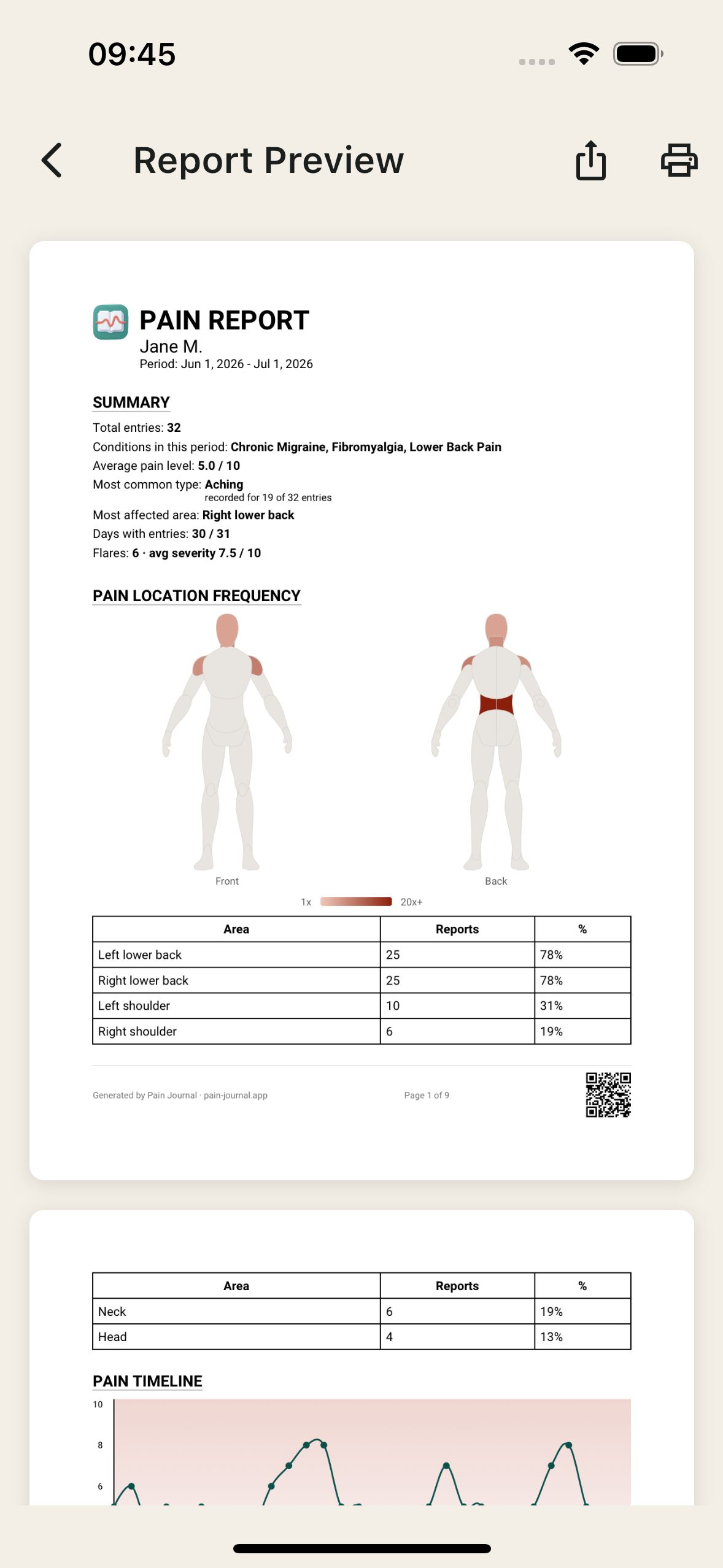
- Map where it is. Pointing to the same areas on a front-and-back body map, week after week, turns "it is everywhere" into a specific, repeatable picture.
- Bring it dated, on one page. A record with dates on it is evidence. A story told from memory is not, however true it is.
What not to do
Two things quietly undercut a strong case. Do not walk in adversarial. The goal is not to win an argument, it is to give the person across the desk something concrete to work from, and a calm document does that better than frustration. And do not lean on memory, even when you are sure of it. The moment your account depends on "I think it was most days," it becomes contestable. A record with dates on it is not.
Put it on one page
The strongest version of all of this is a single sheet you can slide across the desk: a body-map heatmap of where the pain concentrates, how many flare days you had, your worst and average levels, the top trigger or two, and which medications actually helped. It turns a conversation you have to perform into a document you can both read, and it moves the visit from "do you really hurt this much" to "what do we do about this."
Start today
You can build this by hand right now with our free printable pain diary: the body map, the 0-10 scales, and the trigger checklist are already laid out to fill in. When doing it on paper every day gets tedious, Pain Journal logs the same things in a few taps and builds the dated summary for you, free, with no account and no per-export fee.
Going in with a plan for what to say? Read what to tell your doctor about chronic pain. Tracking a specific condition? See how to track fibromyalgia for your doctor.
Common questions
How do you prove chronic pain to a doctor when there is no test for it?
You cannot prove the sensation itself, but you can document it objectively. Log pain in the moment over
several weeks, record how often it happens and how long it lasts, note what it stops you doing, and show
where it concentrates on a body map. Consistency over time is the closest thing to proof there is.
What should I do if my doctor does not believe my pain?
Bring a dated record instead of describing it from memory. A few weeks of logged entries, with frequency,
functional impact, and a body map, turns a subjective account into a document you can both look at, which is
far harder to set aside than a verbal description.
Why does chronic pain get dismissed so often?
A single appointment gives a clinician one moment to go on, and one moment usually looks milder than the
overall pattern. A record spanning weeks shows the frequency and the bad days that a single visit cannot.
Does a pain-tracking app help prove pain to a doctor?
It can, by keeping the record consistent and easy to hand over. Paper works too. Pain Journal logs entries
in seconds and builds a dated summary, with a body-map heatmap, frequency, worst and average pain,
triggers, and medications, for free.