
Your doctor cannot feel your pain. The only thing they can act on is how clearly you describe it, so the description is the part worth preparing.
This guide is general information about tracking pain and preparing for appointments, not medical advice. Talk to your clinician about your own care.
Chronic pain is hard to talk about on the spot. By the time you are in the room, the bad weeks have blurred together and you tend to describe how you feel today, which is rarely your worst. That single habit, anchoring on the present moment, is why so many appointments end with "let us keep an eye on it" instead of a plan. The fix is not talking more. It is bringing five specific things and leading with them.
The five things to bring
If you prepare nothing else, prepare these. They map onto the questions a clinician is already asking in their head:
- Where it hurts. Point to it. Pain that moves or is widespread is far clearer on a body map (front and back) than in words. A picture stops the "and where exactly?" back-and-forth.
- How bad, across the range. Not one number for today, but your worst, average, and best over the last few weeks. The spread tells a doctor more than any single score.
- What it stops you doing. Function is what they treat. "I cannot sit through a workday" or "I stopped walking the dog" lands harder and is more useful than "it is a seven."
- The pattern. When flares hit and what tends to come before them, poor sleep, stress, weather, overexertion, a missed dose. Patterns point at causes.
- What you have already tried. Medications, doses, and whether each actually helped, none, some, or a lot. This stops the visit from re-suggesting what already failed.
How to say it in the first two minutes
Lead with the summary, not the story. Time-pressed clinicians make their plan early, so open with the shape of the whole period: "Over the last six weeks my pain averaged a six, peaked at nine about twice a week, mostly across my lower back and hips, and it is now stopping me sleeping through the night." That one sentence does more than ten minutes of recalling individual bad days. Keep the detail in your back pocket for when they ask.
What not to do
Three habits quietly sink the visit. Do not minimize, many of us downplay pain out of politeness and then wonder why nothing changes. Do not describe only today, you are there about a pattern, not a snapshot. And do not rely on memory, the gap between what actually happened and what you recall in the waiting room is large, and it almost always undersells how hard the period was.
Bring it on one page
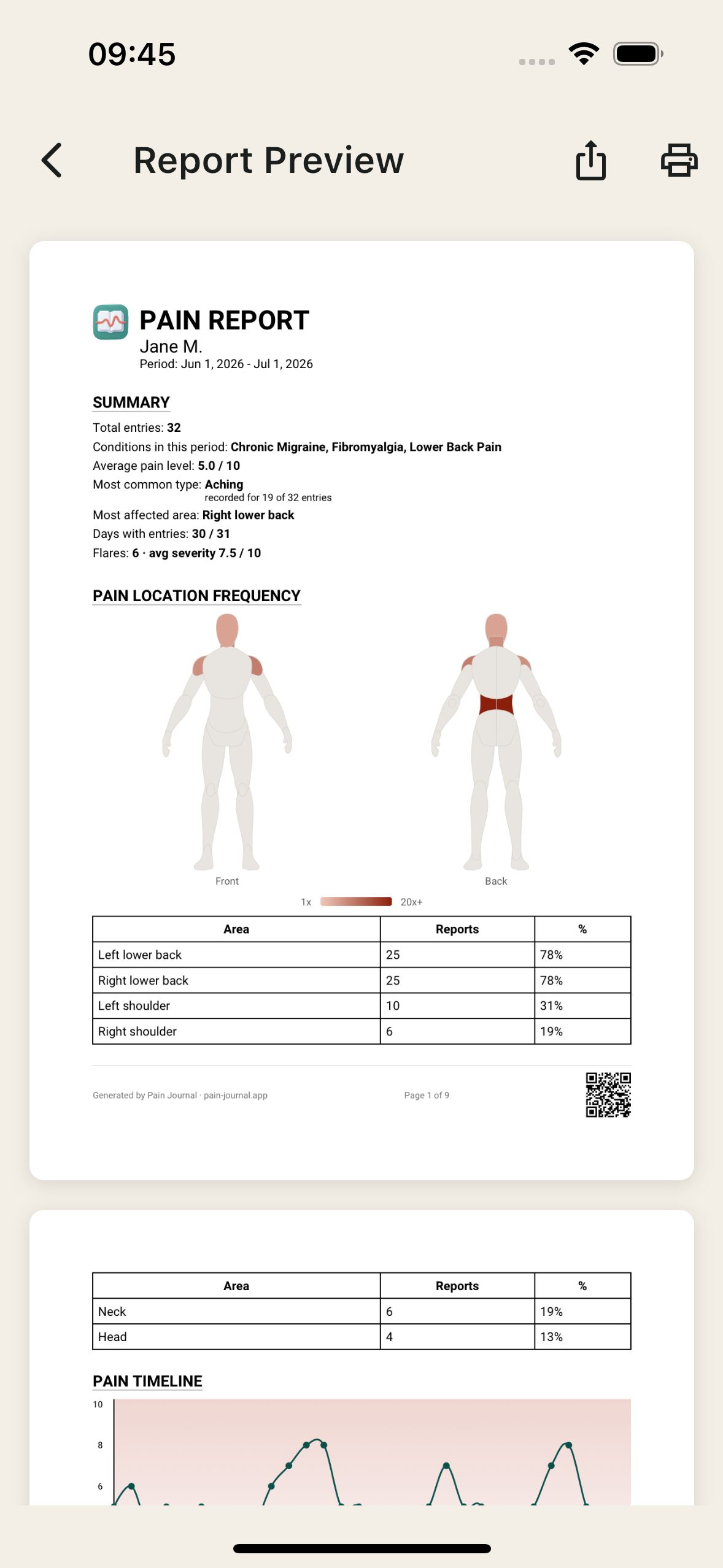
The strongest version of all of this is a single page you hand over: a body map, your worst/average/best numbers, how many flare days you had, the top trigger or two, and which medications helped. It turns a vague conversation into a document you can both look at, and it makes you impossible to dismiss.
Start today
You can build this by hand right now with our free printable pain diary, the body map, the 0-10 scales, the trigger checklist, and the doctor-visit prompts are already laid out. When filling it in by hand gets tedious, Pain Journal logs the same things in a few taps a day and generates the summary for you, free.
Tracking a specific condition? See how to track fibromyalgia for your doctor, or our take on a free Manage My Pain alternative.
Common questions
What should I track before a chronic pain appointment?
Five things: where it hurts (a body map), your worst, average, and best pain over the period, what the pain
stops you doing, the pattern and what tends to trigger a flare, and what you have already tried and whether
it helped.
How do I describe my pain so my doctor can act on it?
Lead with a one-sentence summary of the whole period: your average and peak pain, where it concentrates, and
the main way it limits you. Keep the day-by-day detail for when they ask.
What should I avoid when talking about chronic pain?
Do not minimize it, do not describe only how you feel today, and do not rely on memory. All three make the
period sound milder than it actually was.
Do I need an app, or is paper enough?
Paper is enough, a free printable diary works. An app like Pain Journal just builds the summary for
you automatically and keeps the full history so nothing is lost.