
Your doctor asks "so, how has your pain been?" and your mind goes blank. Weeks of bad days, gone in the one moment they matter most.
This guide is general information about tracking pain and preparing for appointments, not medical advice. Talk to your clinician about your own care.
It is the most common problem in a chronic-pain appointment, and it is not your fault. Pain is hard to remember accurately, flares blur together, and a ten-minute visit is not enough time to reconstruct two months from memory. The fix is simple: walk in with it already written down. This free printable pain diary gives you a structured place to do exactly that.
What is in the printable
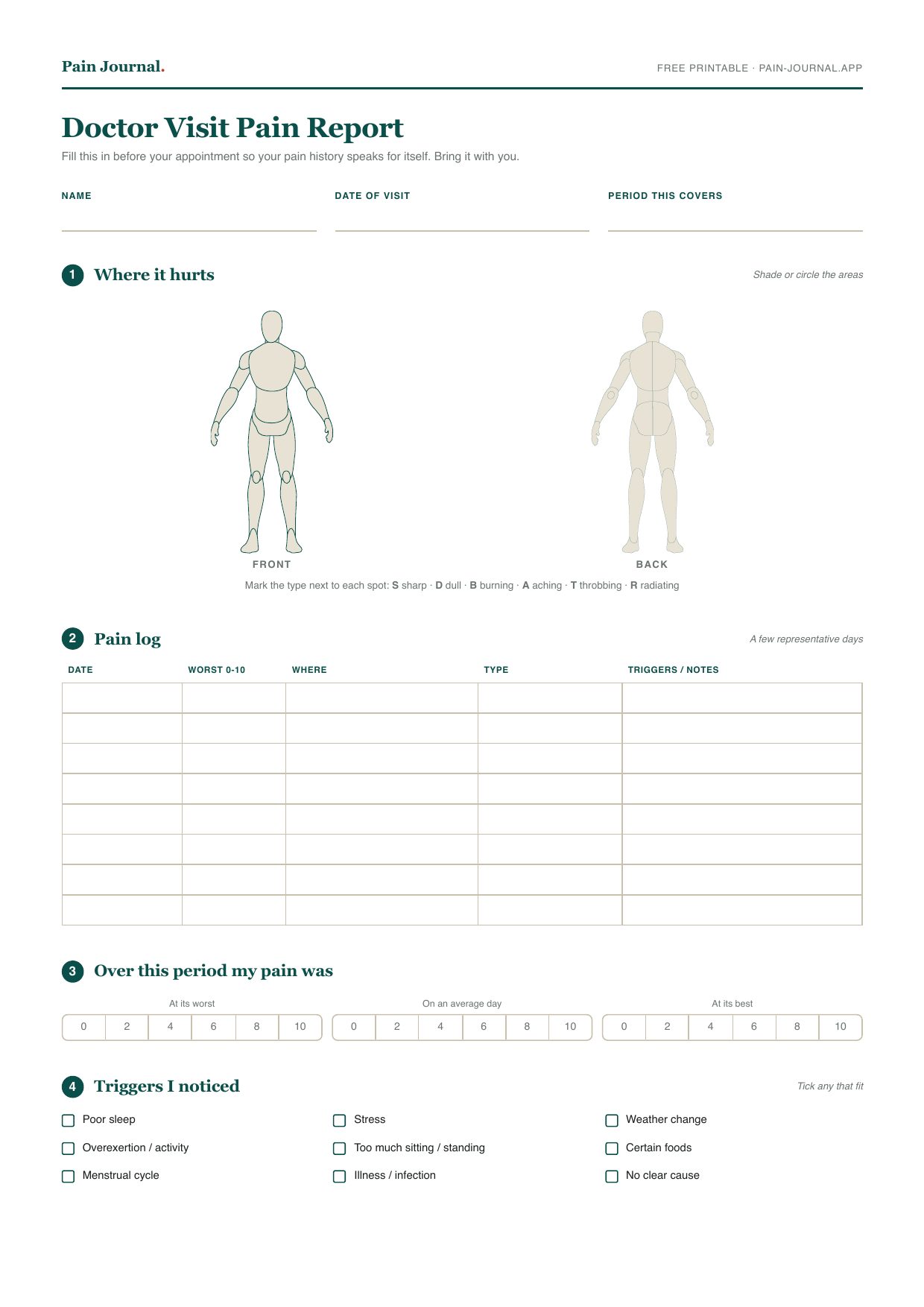
It is a clean, two-page PDF you print and fill in by hand. No app, no account, no email required to download it. It covers the things a doctor actually asks about:
- A front-and-back body map to shade or circle exactly where it hurts, and mark the type (sharp, dull, burning, aching, throbbing, radiating).
- A short pain log for a few representative days: date, worst pain on a 0-10 scale, where, the type, and any triggers or notes.
- Your pain at its worst, best, and on an average day on a 0-10 scale, the summary most clinicians want first.
- A trigger checklist (poor sleep, stress, weather, overexertion, foods, cycle, and more) so patterns become visible.
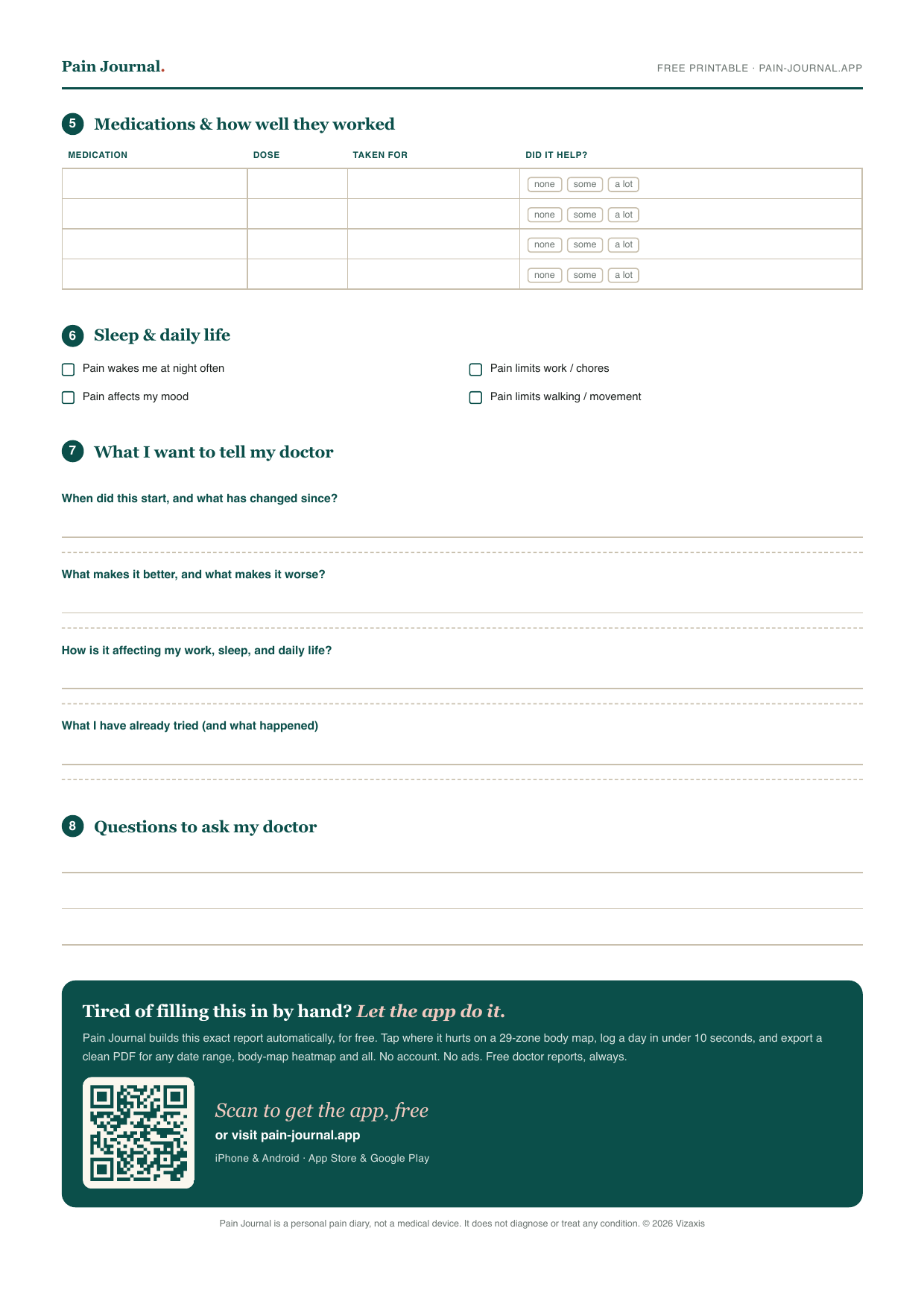
- A medication table for what you took, the dose, and how well it actually worked.
- Prompts for what to tell your doctor and space for the questions you want to ask.
How to use it before your appointment
Print it as soon as you book the visit and keep it somewhere you will see it, on the fridge or by the bed. Jot down a line on your worse days rather than trying to fill the whole thing at once. Even a week or two of notes turns a vague "it has been bad" into something concrete a clinician can act on. On the day, the body map and the worst/average/best numbers give the two-minute summary; the log and the trigger checklist back it up if there is time.
Why bringing data changes the visit
A clear record is harder to wave off, gets you through the history faster, and leaves more of the appointment for the part that matters: what to do next. It also protects you from the "you seem fine today" problem, because a single good day at the clinic does not erase the bad weeks you wrote down. The point is not to perform; it is to make sure the full picture is in the room.
Tracking fibromyalgia, migraine, arthritis, and more
The same printable works for any chronic-pain or symptom pattern, fibromyalgia, migraine and headache, rheumatoid and osteoarthritis, chronic back pain, endometriosis, neuropathy, or autoimmune flares. The body map and trigger list are general on purpose, so you can adapt them to whatever you live with. For fibromyalgia specifically, where fatigue, sleep and fog matter as much as pain, there is a separate fibromyalgia symptom diary with a column for each.
Prefer not to fill it in by hand?
The paper version is great, but doing it every visit gets tedious. That is exactly why we built Pain Journal: it captures all of this in a few taps a day and generates a dated summary of the same fields as a PDF, body-map heatmap included; the last 7 days are free, and longer or custom date ranges are Premium. Whichever you choose, the goal is the same: never draw a blank in front of your doctor again.
Common questions
Is the printable pain diary really free?
Yes. Download the two-page PDF and print it at home, no email, no account, and no sign-up. The Pain Journal app is free too, and builds a summary of the same fields for you; the free doctor report covers the last 7 days.
How many days should I fill in before my appointment?
Even a week or two is enough. Jot a line on your worse days rather than filling the whole thing at once,
so a short record replaces trying to remember two months from memory in the waiting room.
Can I use it for fibromyalgia, migraine, or arthritis?
Yes. The body map and trigger checklist are general on purpose, so the same diary works for fibromyalgia,
migraine and headache, rheumatoid and osteoarthritis, chronic back pain, and other chronic-pain or symptom
patterns.
Do I need the app, or is the paper version enough?
The paper version is enough. The app captures the same things in a few taps a day (its scale runs 1 to 10, the sheet 0 to 10) and builds the summary for you, free for the last 7 days, so you do not fill it in by hand before every visit.