
A first pain management appointment covers a lot of ground quickly. Walking in with it written down means the time gets spent on a plan, not on reconstructing your history.
This guide is general information about preparing for appointments, not medical advice. Your clinic may send its own intake forms, always fill those in too.
A pain clinic works differently from a quick check-in. They tend to look at how your pain has behaved over weeks and months, and to go through everything that has already been tried before, so the appointment leans heavily on history. That history is hard to produce accurately on the spot, especially when you are in pain and on the clock. The fix is to bring it, organized, so nothing important gets left out.
The checklist to bring
Prepare these ahead of time. Together they answer most of what a pain clinic will ask in the first visit:
- A dated pain record. Your levels over the last few weeks (worst, average, best), where it is on a body map, and the pattern, when it flares and what tends to set it off.
- Your full medication list. Every medication and dose you take for pain, and just as important, whether each one actually helped: none, a little, or a lot. This stops the visit from re-suggesting what already failed.
- What you have already tried. Physical therapy, injections, procedures, imaging, specialists, and what each did or did not change. A clinic does not want to start from zero.
- What the pain stops you doing. The work, sleep, and daily tasks it takes from you. Function is concrete, and it is often what the plan is built around.
- Any imaging or reports you hold. Scans, radiology reports, or referral letters you have a copy of. Bring them rather than assume they will be on the system.
- Your top questions, written down. Two or three, in order. Pain and time pressure make questions easy to forget, and a written list makes sure the ones that matter get asked.
Lead with a one-sentence summary
Open with the shape of the whole period rather than the day-by-day story: "Over the last two months my pain averaged a six, peaked at nine a few times a week, mostly across my lower back, and it is now stopping me sleeping and working full days." That single sentence orients the visit, and the dated record behind it is there for every follow-up question.
Put it on one page
The easiest way to carry all of this is a single sheet you can hand over: a body-map heatmap, your worst and average levels, how many flare days you had, the top triggers, and which medications helped. It turns a long recall exercise into a document you can both read at a glance.
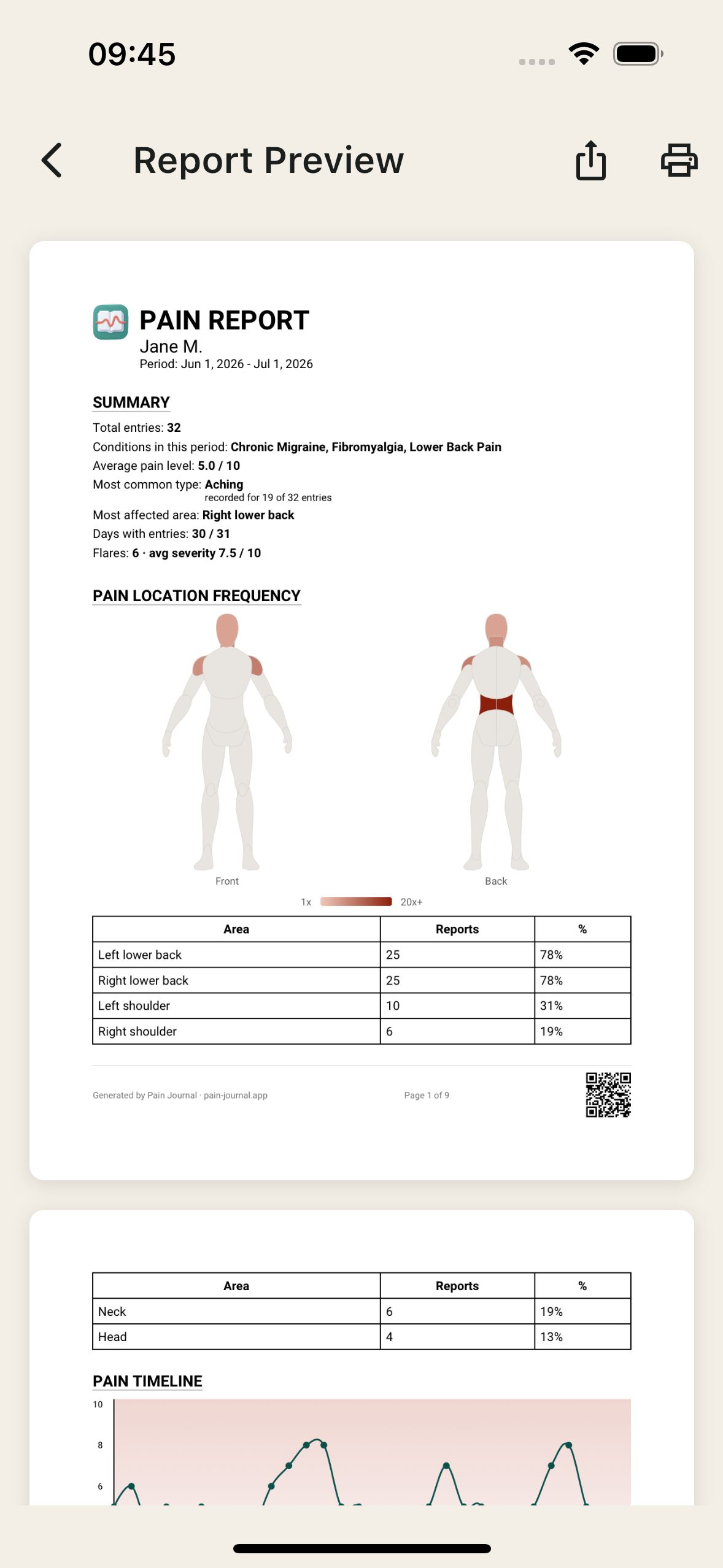
Start today
You can build this by hand right now with our free printable pain diary: the body map, the 0-10 scales, the trigger checklist, and the doctor-visit prompts are already laid out. When filling it in by hand gets tedious, Pain Journal logs the same things in a few taps and builds the dated summary for you, free, with no account.
Not sure how to open the conversation? See what to tell your doctor about chronic pain, or how to prove your pain to a doctor if you have felt dismissed before.
Common questions
What should I bring to a pain management appointment?
Bring a dated record of your pain (levels, where it is, and the pattern), your full medication list with
whether each helped, the treatments you have already tried and their results, a note on what the pain stops
you doing, any imaging or reports, and your top questions written down.
How is a pain management appointment different from a regular visit?
A pain clinic tends to build a picture of your pain over time and review everything that has already been
tried, so the history and what worked or did not is worth having organized before you arrive, not recalled
on the spot.
How do I explain my pain history without forgetting things?
Bring it written down. Lead with a one-sentence summary of the whole period, then hand over a dated record
so the medications, treatments, and their results are on the page instead of pulled from memory under
pressure.
Is there a checklist I can print for a pain management appointment?
Yes. Our free printable pain diary lays out the body map, pain scales, trigger checklist, and doctor-visit
prompts. Pain Journal can also build a dated summary from your entries automatically, for free.