
Nerve pain has a particular way of defeating the appointment. It moves, it changes character, it is worst at two in the morning and quiet at eleven, and the words for it never arrive when someone is waiting for an answer. So the honest summary comes out as "it is hard to explain, it is just always there", which is true and tells a neurologist almost nothing.
This guide is general information about tracking symptoms and preparing for appointments, not medical advice. It does not tell you what your symptoms mean, what is causing them, or what to take. Talk to your neurologist or doctor about your own care.
None of what follows asks you to know anything. It asks you to record five ordinary things on the day they happen, so that the person across the desk is reading a month instead of interviewing your memory.
1. Where it is, marked rather than described
Location is the first thing asked and the first thing that gets vague. "My legs" covers a lot of ground, and the difference between both feet, one shin, and a band around the calf is a real difference. Mark the area on a body outline rather than trying to name it. If it spread this week, mark the new area too and note the date it turned up.
Symmetry is worth capturing without commenting on it. Both sides, one side, or one side much worse: record which, and leave what that means to the appointment.
2. What it feels like, in your own everyday words
This is the part people try hardest to get right and get wrong by reaching for medical language they are not sure of. Your words are better. Burning. Buzzing. Pins and needles. Like cold water running down it. Like standing on gravel. Like a shock that lasts a second and then goes. Like a rope being pulled tight.
Write it the day it happens and reuse the same phrases from then on. A neurologist reads consistency: the same description turning up across six weeks, or a description that changes, are both information. A thesaurus in the waiting room is not.
3. Numbness and the symptoms that do not hurt
The parts that go quiet get left out because they are not painful, and they belong in the record just as much.
- Reduced feeling. Where, and whether it is new since last time.
- Clumsiness. Dropping things, catching a foot on a step, buttons taking longer.
- Temperature oddities. A limb that feels cold to you and is not, or the other way around.
- Skin sensitivity. Bedsheets, socks or a waistband being unbearable on a given day.
Note it as an observation, on a date. That is the whole job.
4. Nights, separately from days
Neuropathic symptoms have a habit of arriving when everything else stops, and "it is worse at night" is a sentence every clinician has heard. What is useful is the specific version: how many nights this week it woke you, roughly what time, and whether you got back to sleep. Three numbers, entered as they happen.
Keep it descriptive. You are recording that you were awake at 3am on four nights, not diagnosing why.
5. What it stopped you doing
Function is the part patients leave out and clinicians act on. A walk cut short, a shift worked at half capacity, driving avoided, stairs taken one at a time, a day where the shopping did not happen. Attach it to the date and keep it to one line.
A month of 6-out-of-10 days reads very differently when five of them cost a working day, and you will not remember which five when you are asked.
Context, without conclusions
If you want to record what was going on around a bad stretch, record it as plain fact beside the date: a long drive, a cold snap, a missed dose, a week of poor sleep, a new pair of shoes. The trap is doing the analysis yourself in the moment and writing down a cause instead of an observation, because once you have decided what sets your symptoms off you stop noticing everything else. Log the day, not the theory.
Bring one page
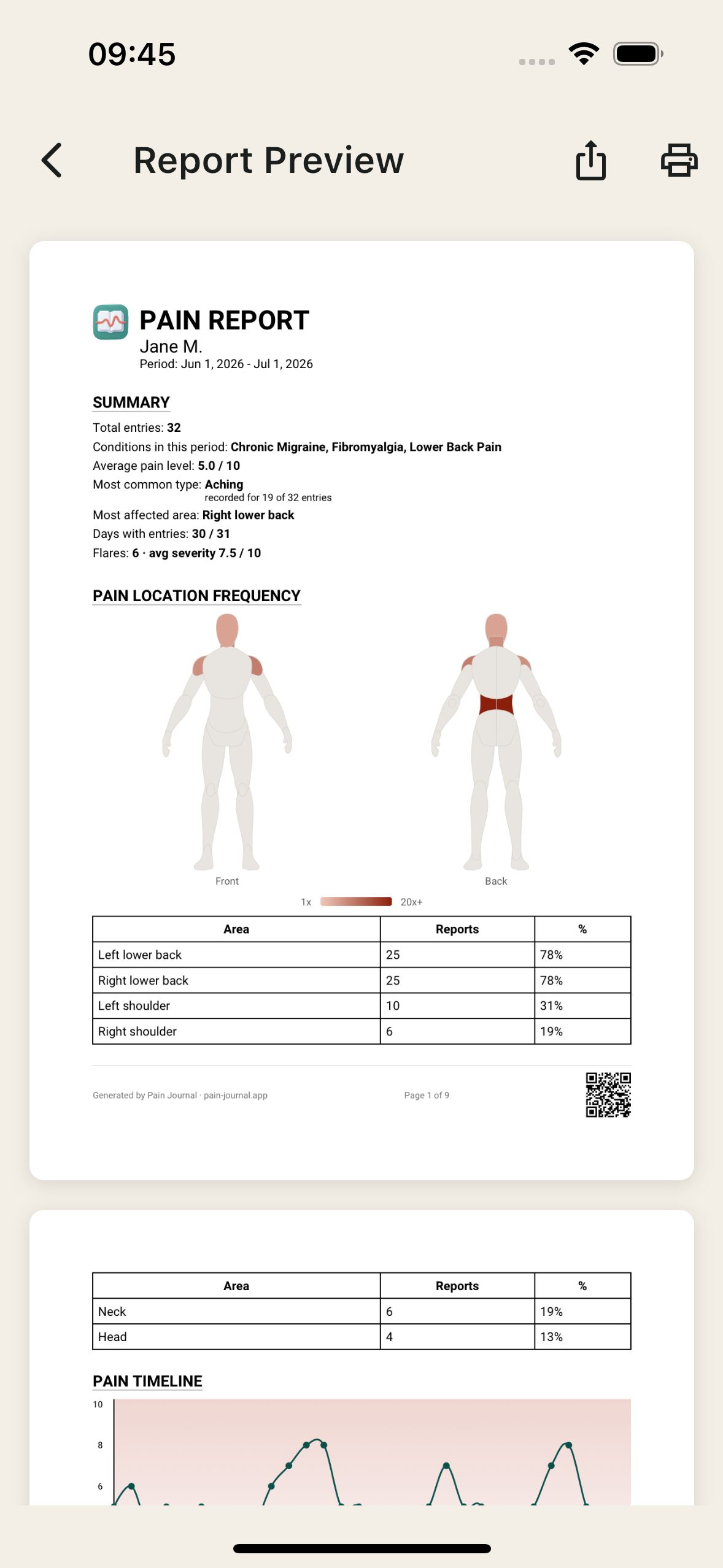
Nobody is reading eight weeks of daily entries in a fifteen minute appointment, and a thick notebook usually ends up politely set aside. What works is a summary: the areas marked on a body map, the typical and worst numbers, the descriptions that repeated, the nights disturbed, and the days lost. The detail sits underneath for when they ask for it.
How often to log
Once a day, in seconds, including the quiet days. That is the method. The failure mode is not missing entries, it is building yourself an elaborate daily form in week one and abandoning it by week three, which leaves you back at recalling from memory with the added irritation of having tried. A record is a sample, not an exam.
Start today
You can do all of this on paper with our free printable pain diary, which already has the 0-10 scales and the body map laid out. When the daily writing gets tedious, Pain Journal records the same things in a few taps and builds the summary for you, free, with no account. The free doctor report covers the last 7 days, with no credits and no per-export fee.
Next: how to describe your pain to a doctor, or what to bring to the appointment.
Common questions
What should I track for nerve pain before a neurology appointment?
Where the symptoms are on your body, what they feel like in your own everyday words, a 0-10 number for the
day, whether anything set them off or calmed them, how the night went, and what you could not do because of
them. Dates, locations and plain descriptions are what the appointment runs on.
How do I describe burning, tingling or electric pain without using medical words?
Use the words you would use to a friend. Burning, buzzing, pins and needles, like cold water running down
it, like standing on gravel, like a shock that lasts a second. Plain description is more useful to a
clinician than a borrowed term, because it is yours and it stays consistent from visit to visit. Write it
down on the day rather than reaching for it in the room.
Should I track numbness as well as pain?
Yes. Numbness, reduced feeling and clumsiness are part of the same picture and they are the parts people
forget to mention because they do not hurt. Note where you noticed it and whether it was new. You are
recording an observation, not deciding what it means.
How long should I track before a neurology appointment?
Ideally the whole gap since your last visit, because a neurologist is looking at whether the pattern is
spreading, steady or changing, and that is a comparison over time. If the appointment is close, two to four
weeks of one-line daily entries still beats reconstructing months from memory in the waiting room.
Do I need to write down the good days too?
Yes, and it is the step most people skip. A record that only exists on bad days is a list of bad days, not a
month, and it makes everything look constant. A quiet day marked as quiet takes a second and it is what
turns your entries into a pattern somebody can read.