
Almost every migraine appointment opens with a number: how many days a month are you getting head pain. It sounds like an easy question and it is close to unanswerable from memory, because the attacks that stay with you are the bad ones and the ordinary ones vanish.
This guide is general information about tracking symptoms and preparing for appointments, not medical advice. It does not tell you what your symptoms mean, what is causing them, or what to take. Talk to your neurologist or doctor about your own care.
Migraine is unusually well suited to being tracked, because the things a neurologist asks about are countable: days, hours, sides, dates. None of it requires you to interpret anything. It only requires that the record exists before you are sitting in the room trying to remember whether that bad week was this month or the one before.
1. Headache days per month, including the clear ones
This is the number the appointment turns on, and it is a count, which means it needs a denominator. If you only write things down on bad days, you have a list of bad days and no month. Mark the clear days too, even if it is a single tap. Four weeks of days marked one way or the other gives an honest "eleven days last month, and nine of them in the second half".
It also settles an argument you may be having with yourself. People with frequent migraine often underestimate their own count when asked cold, and overestimate it after a bad fortnight. The record is not there to catch you out. It is there so the number you give is not a mood.
2. How long each attack lasted, and which side
Duration matters and is easy to lose. Note roughly when it started, roughly when it ended or when it became liveable, and whether it was one side, the other, or all over. If you took something, note that the timeline includes it rather than trying to separate out what would have happened otherwise. That is not yours to work out and nobody expects you to.
Attacks that end because you slept are worth marking as exactly that. "Gone by morning" and "gone after four hours" are different shapes, and they are worth keeping apart.
3. The other symptoms, recorded as observations
Head pain is only part of what is asked about. The rest tends to come out as a vague "yeah, sometimes" unless it was written down at the time.
- Aura or visual changes. What you saw or felt, when it started relative to the pain, and how long it lasted. Describe it plainly, not in medical terms you are not sure about.
- Nausea, light and sound sensitivity. Present or not, on which attacks. A pattern across a month is a real answer.
- The hours before and after. Some people notice a run-up, some notice a flattened day afterwards. Note what you noticed. You are recording, not diagnosing.
4. Medication dates, not medication verdicts
Write down what you took and on which dates, including the days you took something twice. Acute medication days per month are a routine part of the history a neurologist takes, and the count is only useful if it is accurate. Resist the urge to grade whether something worked, and resist the stronger urge to leave a day out because it feels like too many. That instinct is understandable and it quietly corrupts the one number your appointment most needs.
What those counts mean is the conversation you are going there to have. Your part is the dates.
5. What it cost you
Function is the part patients leave out and clinicians act on. Work days missed or worked through at half capacity, plans cancelled, driving avoided, a day spent in a dark room. Attach it to the date of the attack and keep it to one line. Nine attacks in a month reads differently when four of them cost a working day, and you will not remember which four by the time you are asked.
6. Context, without conclusions
Sleep, meals, cycle phase, workload, weather, a long drive: if you want to record context alongside attacks, record it as plain fact next to the date. The trap is doing the analysis yourself in the moment and writing down a cause instead of an observation, because once you have decided what triggers your attacks you stop noticing everything else. Log the day, not the theory.
Bring one page
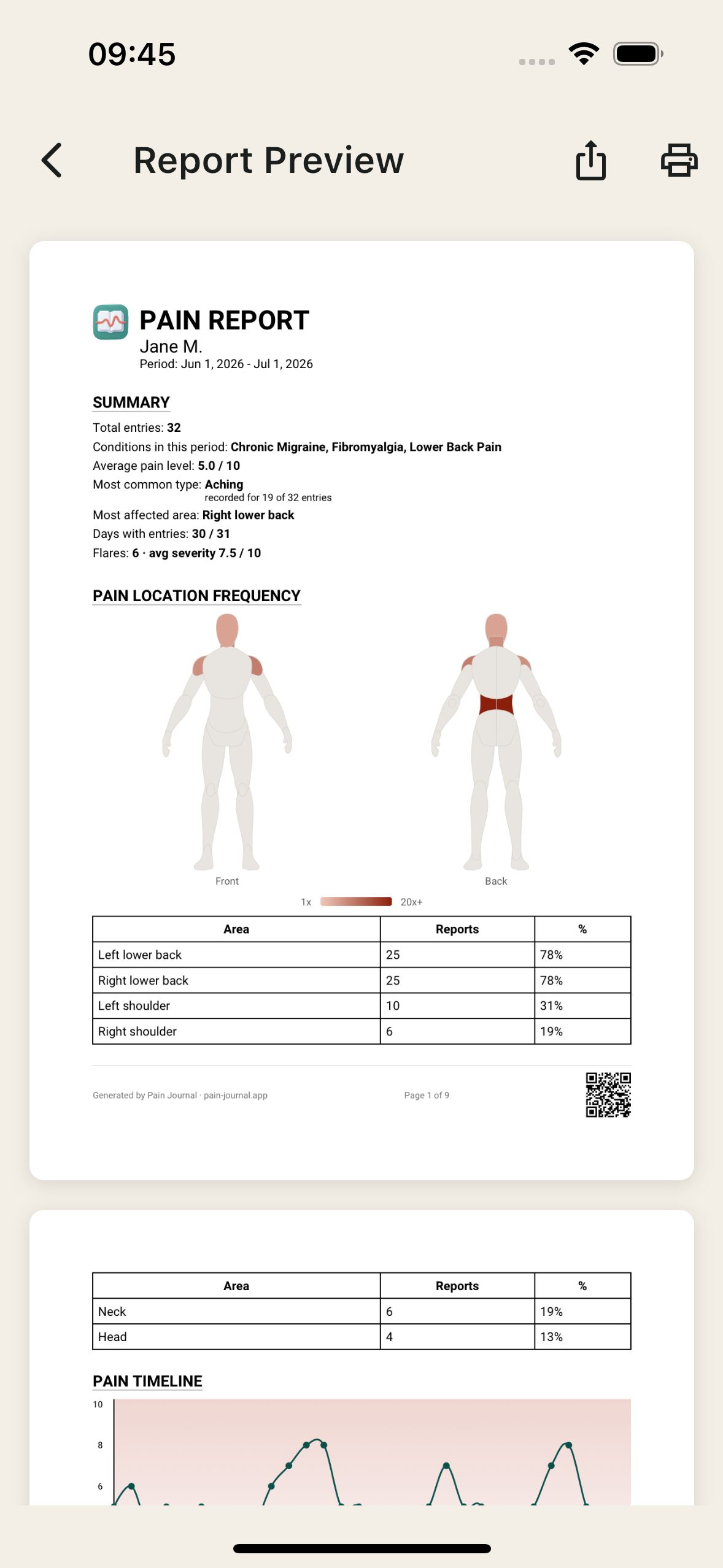
Nobody is reading three months of daily entries in a fifteen minute appointment, and a thick notebook usually ends up politely set aside. What works is one summary page: headache days per month, the attack durations, the medication day count, the symptoms that showed up most, and the days lost. The detail sits underneath for when they ask for it.
How often to log
Once a day, in seconds, including the clear days. That is the whole method. The failure mode is not missing entries, it is building yourself an elaborate daily form in week one and abandoning it by week three, which leaves you back at recalling from memory with the added irritation of having tried. A record is a sample, not an exam.
Start today
You can do all of this on paper with our free printable pain diary, which already has the 0-10 scales and the body map laid out. When the daily writing gets tedious, Pain Journal records the same things in a few taps and builds the summary for you, free for the last 7 days, with no account.
Next: how to describe your pain to a doctor, or what to bring to the appointment.
Common questions
What should I track for migraine before a neurology appointment?
The date of every day you had head pain, how long each attack lasted, which side, the other symptoms you
noticed such as aura, nausea or light and sound sensitivity, the dates you took anything for it, and what
the attack stopped you doing. Dates and counts are what the appointment runs on.
How many months of migraine tracking does a neurologist want to see?
Usually at least one full month, and ideally the whole gap since your last visit, because migraine frequency
is counted per month and a partial month cannot be compared to anything. If your appointment is soon, four
weeks of one-line daily entries is still far better than reconstructing it in the waiting room.
Should I log days when I had no headache at all?
Yes, and it is the part most people skip. Headache days are counted against the days you did not have one,
so a record that only exists on bad days makes the month look either worse or emptier than it was. A clear
day marked as clear takes a second and it is what makes the count real.
Why does my neurologist ask how many days I took medication?
Acute medication days per month are a standard part of the history a neurologist takes, alongside headache
days. Your job is only to record the dates accurately, not to interpret them or to judge yourself for them.
What those counts mean for your treatment is the conversation you are going to the appointment to have.