
Most back pain is mechanical, which means it rises and falls with movement and position. That is exactly the part a good record captures and a rushed appointment misses.
This guide is general information about tracking pain and preparing for appointments, not medical advice. If your back pain comes with new weakness, numbness in the groin, or loss of bladder or bowel control, treat that as urgent and seek care right away.
When someone with back pain is asked "how bad is it," a single number rarely helps, because the same back can feel like a two lying down and a nine after twenty minutes in a car. What a clinician can actually work from is the shape of it: what sets it off, what settles it, and what it has stopped you doing. Tracking a few specific things over a couple of weeks turns "my back hurts" into that shape.
What to log for back pain
You do not need to record everything. These are the fields that carry the most information into an appointment:
- Where it is, and whether it travels. Lower or upper, left or right, central or to one side, and crucially whether it radiates into a buttock or down a leg. Pain that shoots down a leg is a different note than pain that stays in the back.
- How bad, across a range. Your worst, average, and best over the last few weeks, not one score for the moment you happen to be in the room.
- The position that makes it worse. Sitting, standing, bending forward, lifting, lying down. This is the single most useful field for back pain, and the one most people leave out.
- What eases it. Walking, lying flat, heat, a change of position. What helps is as much a clue as what hurts.
- What it stops you doing. The drive you cut short, the shift you could not finish, the sleep you lost. Function is concrete and checkable in a way a pain score is not.
The positional pattern is the part worth catching
Because back pain is mechanical, the relationship between position and pain is often the most telling thing you can bring. Worse sitting and better walking, or the reverse, is a real, repeatable pattern, and it is far more useful to a clinician than "it is a seven." You do not need to interpret it, and this guide will not try to, that is their job. Your job is only to have it written down, dated, so the pattern is on the page instead of half-remembered in the waiting room.
How often to track it
A quick daily note is plenty, plus a proper entry every time it flares. Catch the flare in the moment: what you were doing, which position set it off, how bad it got, and how long it lasted. A flare logged an hour later is accurate. A flare reconstructed three weeks later at the appointment is not, and it almost always undersells how the month actually went.
Put it on one page
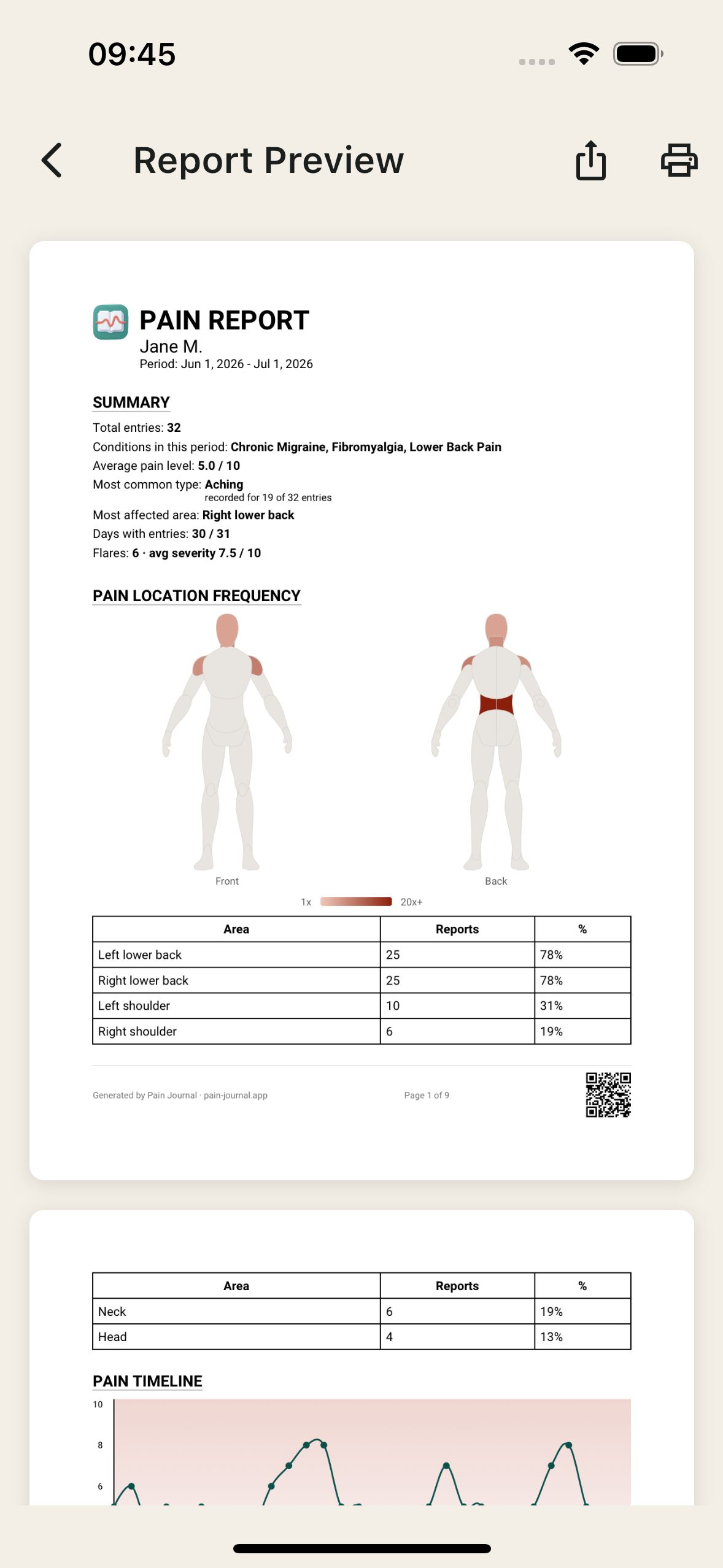
The strongest version of all of this is a single sheet: a body map of where the pain sits and where it radiates, your worst and average levels, how many flare days you had, the positions that set it off, and what you have already tried. It turns a vague conversation into a document you can both look at.
Start today
You can build this by hand right now with our free printable pain diary: the body map, the 0-10 scales, and the trigger checklist are already laid out. When doing it on paper every day gets tedious, Pain Journal logs the same things in a few taps and builds the dated summary for you, free, with no account.
Heading in feeling unheard? Read how to prove your pain to a doctor, or what to tell your doctor about chronic pain for the first two minutes of the visit.
Common questions
What should I log for back pain before a doctor visit?
Log where it is (and whether it radiates into a leg), how bad across a range, which positions or movements
make it worse or better, what you were doing when it flared, and what it stops you doing. A few weeks of
that shows a pattern a single visit cannot.
Why does the position that makes back pain worse matter?
Back pain is usually mechanical, so noting whether it is worse sitting, standing, bending, or lying down,
and what eases it, is some of the most useful information you can bring. It is a pattern a clinician can
work from, where a single pain score is not.
How often should I track back pain?
A quick daily note plus an entry for every flare is enough. Capture the flare in the moment, with what you
were doing and which position set it off, so the trigger is not lost by the time you reach the
appointment.
Do I need an app to track back pain, or is paper enough?
Paper works, a free printable diary is enough. An app like Pain Journal just builds the summary for
you, with a body map and a pain timeline, and keeps the full history so nothing is lost between visits.