
The hardest part of a hypermobility appointment is not the examination. It is the fifteen minutes beforehand, when you have to compress months of symptoms that never sat still into a few sentences, and the honest answer that comes out is "it moves around, it depends".
This guide is general information about tracking symptoms and preparing for appointments, not medical advice. It does not tell you what your symptoms mean, whether you have any particular condition, or what to do about them. Talk to your doctor about your own care.
Symptoms that migrate are not vaguer than symptoms that stay put. They are just impossible to hold in your head. A joint that hurt for two days three weeks ago is gone from memory by the appointment, and what survives is the one bad week, which then stands in for everything. A dated record fixes that without asking you to understand anything about your own case.
1. Which joint, and what it did
Location first, and be specific about the side. Left wrist is a different entry from right wrist, and over two months the difference between "my wrists" and fourteen entries that are all the left one is the whole point.
Then what it did that day, in your own plain words: hurt, ached afterwards, felt loose, gave way, went out and came back. Write what happened, not what you think it was. "Knee gave way going downstairs, twice" is a usable line. "Probable subluxation" is you doing a job that is not yours, and it makes the record weaker rather than more medical.
2. Dates, including the quiet days
Counting needs a denominator. If entries only exist on bad days you have a pile of bad days and no idea what share of the month they were. Mark the ordinary days too, even as a single tap, so that "eleven days out of thirty, and eight of them in the second half" is available instead of an impression.
This also protects you from the two directions memory fails in. After a rough fortnight everything feels constant. On a good morning in a waiting room it feels like you are exaggerating. The record is not there to judge you either way, it is there so the number you give is a number.
3. Fatigue, and the day after
Fatigue is often the symptom patients most want taken seriously and find hardest to describe, because it has no location and no obvious scale. Give it a line of its own each day and treat it exactly like pain: how heavy, and what it stopped.
Pay particular attention to the day after an active one. If you notice that a normal day out is paid for the next morning, that pattern is only visible if both days are in the record, next to each other, dated. Nobody can reconstruct it later.
4. What you were doing at the time
Position and load are the context that turns a symptom list into something a clinician can work with. Standing for six hours, carrying shopping up two flights, a long drive, an hour at a laptop, a shift on your feet behind a counter. One short clause attached to the date is enough.
The trap here is the same one everywhere in this guide: writing down a cause instead of an observation. Once you decide what sets your symptoms off, you stop noticing everything that does not fit. Record the day, not the theory, and let the pattern show up on its own.
5. Anything you tried, as dates rather than verdicts
Note what you did and when, including appointments, exercises you were given, braces or supports, and anything you took, with the dates. Do not grade whether it worked. Effectiveness over weeks is not something anyone can judge honestly in the moment, and a record full of your own verdicts is harder to read than one full of facts.
What those dates mean is the conversation you are going to the appointment to have. Your part is that they are accurate.
6. What it cost you
Function is the part people leave out of the summary and clinicians act on. Work missed or worked through at half capacity, a shift you could not finish, stairs avoided, plans cancelled, the meal you could not make standing up. Attach it to the date and keep it to one line. Eleven painful days read very differently when four of them cost a working day, and you will not remember which four.
Do not score yourself
It is tempting to arrive with a self-assessment, especially after reading about how joints get measured. Resist it. That assessment is a physical examination performed by a clinician, and a number you assigned yourself is not something they can use. The thing they genuinely cannot get any other way is the history: what your joints actually did, on which days, over the weeks you were not in front of them. That is yours to bring, and it is worth more.
Bring one page
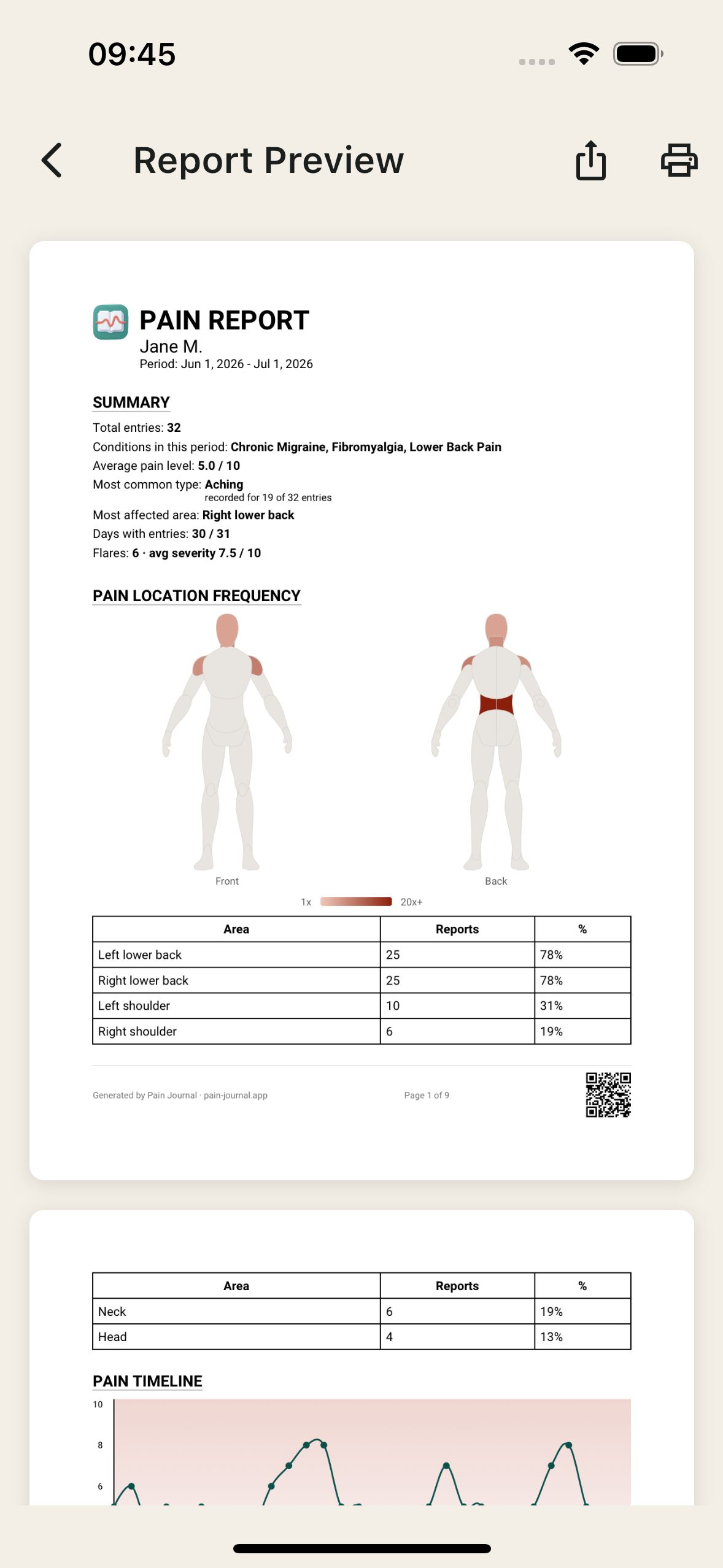
Nobody is reading eight weeks of daily entries in a short appointment, and a thick notebook usually gets politely set aside. What works is a single summary page: which joints came up most and how often, the symptom days against the total, the fatigue pattern, and the days you lost. The detail stays underneath for when they ask for it.
How often to log
Once a day, in seconds, quiet days included. That is the entire method. The failure mode is not a missed entry, it is designing an elaborate daily form in week one and abandoning it by week three, which leaves you back at remembering, now with the added irritation of having tried. A record is a sample, not an exam.
Start today
You can do all of this on paper with our free printable pain diary, which already has the 0-10 scales and the body map laid out, so the joint locations are a mark rather than a sentence. When the daily writing gets tedious, Pain Journal records the same things in a few taps and builds the summary for you, free for the last 7 days, with no account.
Next: how to describe your pain to a doctor, or what to bring to the appointment.
Common questions
What should I track for hypermobility before an appointment?
Which joints hurt on which dates, what each one did that day such as giving way or feeling loose, how long
the pain stayed, the fatigue that followed, what you were doing or holding at the time, and what you could
not do afterwards. Record it as plain observation, dated, without deciding what any of it means.
Should I score my own joints before I see a doctor?
No. Joint assessment is an examination a clinician performs, and a self-assigned score is not a substitute for it. What is genuinely useful, and what they cannot get any other way, is a dated record of what your
joints actually did over the weeks before the appointment.
How do I describe pain that moves between joints?
By date and location rather than in general terms. Fourteen entries showing left shoulder, then right knee,
then both hips over three weeks says something a sentence like "it moves around" cannot. The pattern is the
finding, and it only exists if each day was written down when it happened.
How long should I track before an appointment?
Whatever time you have, and it is worth starting even if the appointment is next week. Two weeks of one-line
daily entries beats reconstructing months in the waiting room, and if you keep going, the record covers the
gap until the next visit as well.