
The gap is the problem. When things are stable a rheumatologist may see you every three to six months, and by the time you are in the room the whole period has compressed into how you happen to feel that morning.
This guide is general information about tracking symptoms and preparing for appointments, not medical advice. It does not tell you what your symptoms mean or what to do about them. Talk to your rheumatologist about your own care.
Rheumatoid arthritis has one advantage over most chronic conditions when it comes to preparation: the appointment asks a fairly predictable set of questions. Stiffness, joints, flares, fatigue, function. That means you can arrive with the answers recorded rather than assembled under time pressure, in a room, while trying to remember March.
1. Morning stiffness, in minutes
Most RA appointments open with some version of "how long does it take you to loosen up in the morning?" The question is asked in minutes because minutes compare cleanly across visits, and it is one of the hardest things to answer honestly from memory. You will remember the worst morning and this morning, and almost nothing in between.
One number on waking is enough. Over a few months that turns into a real answer: "mostly twenty to forty minutes, but six mornings over two hours, and those clustered in the same fortnight." That is a shape. "It varies" is not.
2. Which joints, and whether they were swollen or only sore
"My hands hurt" is how most RA visits start and it is the sentence that loses the most information. Joint counts are part of how disease activity is assessed, and tenderness and visible swelling are recorded separately. You are not being asked to examine yourself or to decide what anything means. You are being asked which joints were involved and when, and that part is just observation.
- Name the joint, not the region. Left index knuckle and both wrists is a different record from "my hands".
- Note the side. Whether it was one side or both is worth one word, and RA often moves.
- Separate sore from puffy. Painful to use, or painful and visibly swollen or hard to bend. Record what you saw, not a conclusion.
This is the part where tapping a body map beats writing sentences, because the pattern usually changes between entries and re-describing it in words every time is what makes people stop tracking by week three.
3. Flares, with dates on them
A flare remembered as "a bad couple of weeks sometime last month" cannot be lined up against anything. A flare with a start date, an end date, the joints involved and one line on what it stopped you doing can be. Four dated flares across six months is a pattern your rheumatologist can look at. Four remembered flares are an impression, and impressions get discounted, including by you.
4. Fatigue, on its own scale
Fatigue is often among the most disabling parts of rheumatoid arthritis and often goes unreported, partly because it feels like complaining rather than reporting, and partly because it is genuinely hard to reconstruct after the fact. Give it a number of its own on paper, or a line in the note, and record it on ordinary days too, not only bad ones. (Pain Journal has no separate fatigue scale; it goes in the entry's note.) Fatigue sitting at a seven on days when joint pain is a three is a real observation, and it is completely invisible if fatigue only ever gets written down alongside a flare.
5. Function: what it actually stopped
Function is the part clinicians act on and the part patients leave out. It is also the most concrete thing you own. Jar lids, buttons and zips, a full keyboard day, stairs, carrying shopping, washing your hair, driving. Write the date you stopped, or the date it started costing you something. "I have not been able to do buttons unaided since April" is dated, specific and impossible to reinterpret as minor.
6. Medication timing, not medication opinions
Record what you took and when, including doses missed and days late, plus what the following days looked like on the scales you are already using. Keep it to what happened. Whether something is working is a question for the appointment, and it is far easier to answer there when the dates are in front of both of you rather than being reconstructed out loud.
Bring one page, not a notebook
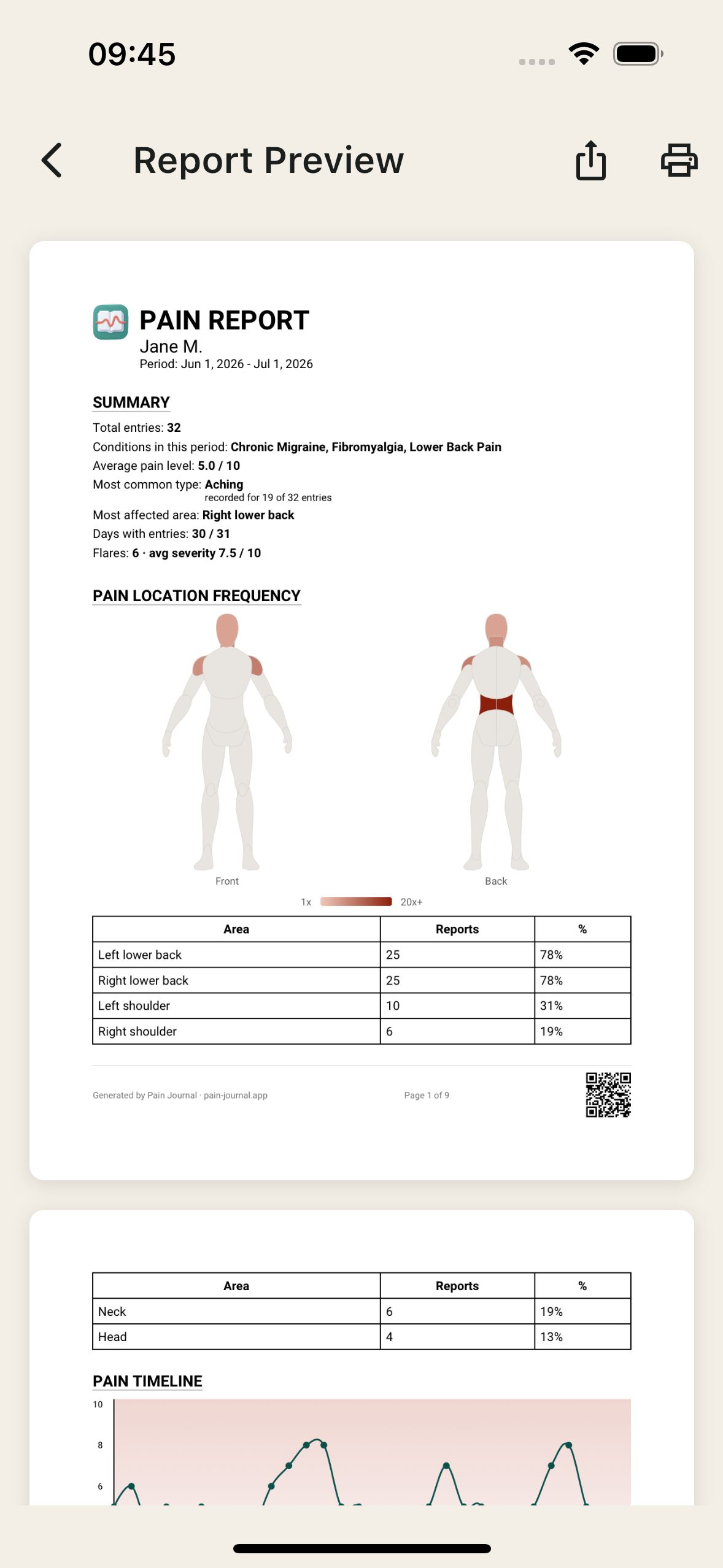
Nobody is going to read six months of entries during a fifteen minute appointment, and handing over a thick notebook usually ends with it being put politely to one side. What works is a single summary page: the stiffness range, the joints most often involved, the flare dates, the fatigue and pain averages, and the function line. Detail underneath for when they ask.
How often to log
Once a day, in under a minute, is enough, and missing days does not ruin anything. A record is a sample, not an exam. The failure mode is not gaps, it is designing yourself a ten minute daily ritual in week one and abandoning the whole thing by week three, which leaves you back at recalling from memory with the added annoyance of having tried.
Start today
You can do all of this on paper with our free printable pain diary, which already has the body map and the 0-10 scales laid out. When the daily writing gets tedious, Pain Journal records the same things in a few taps, marks the affected regions on a 39-zone body map (individual finger joints go in the note), and builds the summary for you, free for the last 7 days, with no account.
Next: how to describe your pain to a doctor, or what to bring to the appointment.
Common questions
What should I track for rheumatoid arthritis?
Morning stiffness in minutes, which specific joints were involved and on which side, dated flares with a
start and end, fatigue on its own 0-10 scale, and what the disease stopped you doing. Medication timing is
worth recording too, as dates rather than opinions about what worked.
How long before my rheumatology appointment should I start tracking?
Ideally from the visit before, because rheumatology appointments are usually three to six months apart and
the whole gap is what you are being asked about. If you are starting late, two to four weeks of daily
one-line entries is still far more useful than recalling the period from memory.
Do I need to record whether a joint was swollen or just painful?
It is worth separating them if you can, because tenderness and visible swelling are recorded differently at
a rheumatology visit. You are not examining yourself or making a judgement, you are noting what you
observed: sore, or sore and visibly puffy or stiff to bend.
Is an app better than a notebook for tracking rheumatoid arthritis?
A notebook works if you keep it up and can summarise it later. An app helps mainly with two things RA makes
tedious: marking which specific joints were involved when the pattern moves, and producing a summary without you rereading every page the night before the appointment (the free report covers the last 7 days; several-month windows are Premium).