
The gap between rheumatology appointments is long, and the question at the start of the next one is some version of how have you been since I saw you. Answering that honestly from memory means compressing three or six months into a couple of sentences, in a room, under time pressure, while the worst week you had is competing with the two good weeks that came after it.
This guide is general information about tracking symptoms and preparing for appointments, not medical advice. It does not tell you what your symptoms mean, whether you are having a flare, or what to do about them. Talk to your doctor about your own care.
What usually comes out is a summary. It has been up and down. Mostly all right. Bad for a while in the spring. All of that may be perfectly true, and none of it can be checked, compared against last time, or returned to at the next visit. A dated record replaces the summary with the underlying days, and it does that without asking you to interpret anything.
1. Record the days, not the flares
This is the one rule that matters most on this page, and it is the opposite of what most people do. Write down what happened on a given day. Do not write down that the day was part of a flare.
Whether a run of bad days is disease activity is a judgement your rheumatologist makes with an examination and bloods in front of them. If your record says "flare, days 3 to 11", it has already collapsed eight days of observation into one word, and the observation is the part nobody else can reconstruct. If it says which joints hurt on which days, how long it ran, and what you could not do, then both readings stay available: yours and theirs.
This is not a small distinction. A record made of facts is one another person can work with. A record made of your own verdicts is one they have to unpick before they can use it.
2. Joint pain, by location and by side
Mark where it sat each time rather than writing "joint pain" every entry. Hands, wrists, knees, ankles, shoulders, and keep left and right as separate entries.
The distribution across two months is information in a way the phrase is not. If it turns out that most of the bad days were the same few joints, or that it moved around, that is the sort of thing you would never reconstruct afterwards and would never think to mention out loud. It also gives you something concrete to point at when you are asked whether anything has changed since last time.
3. Fatigue, measured by what it cost
Fatigue is often the symptom patients find hardest to describe, because a number for tiredness barely compares against itself a month later. Record it as what it stopped, not as a score.
Slept nine hours and could not do the shopping. Back in bed by two. Cancelled a shift. Managed work but nothing after it. Those are dated, concrete and comparable, and they hold up when someone asks how sure you are. Six of those lines in a month say something a single sentence about being exhausted cannot.
4. Everything else, in your own plain words
Note the other things that turned up, on the day they turned up, in ordinary language and without deciding what any of them signify. A rash and where it was. A temperature. Mouth ulcers. Hair coming out. Swelling, and where. A day out in the sun and what followed it. Chest discomfort. Anything new.
You are not building a case and you are not sorting these into what belongs to lupus and what does not. You are making sure that in four months there is still a dated line saying it happened, instead of a vague sense that something did. Sorting is the appointment's job.
5. The days you lost
Function is the part patients leave out and clinicians act on. Work missed or worked through at half capacity, a shift you could not finish, plans cancelled, a day spent horizontal, help you had to ask for.
Attach it to the date, one line each. Fourteen bad days read very differently when six of them cost a working day, and you will not remember which six. This is also the part that is usually asked for if the record is ever needed for work, study, or an insurance or benefits form later.
6. What you took and what changed, as dates
Note medication with the dates you started, stopped, or changed anything, plus infections, appointments, bloods, and anything a clinician told you to watch for. Dates only.
Do not grade whether something worked. Judging that over months, from inside it, is genuinely hard, and your rheumatologist is going to want to read the timeline against results you cannot see. Whether a change helped is the conversation you are going to the appointment to have. Your job is that the dates are right.
Bring the record, not the conclusion
Plenty of people arrive having read for months and having reached an answer, sometimes the right one. It is still worth leading with the history. What is happening inside a body with lupus is settled with examination and laboratory results, not in a notebook, and a dated account of what your body actually did between visits is the one thing in that room nobody else can produce. It stays useful no matter which way the rest of it goes.
Bring one page
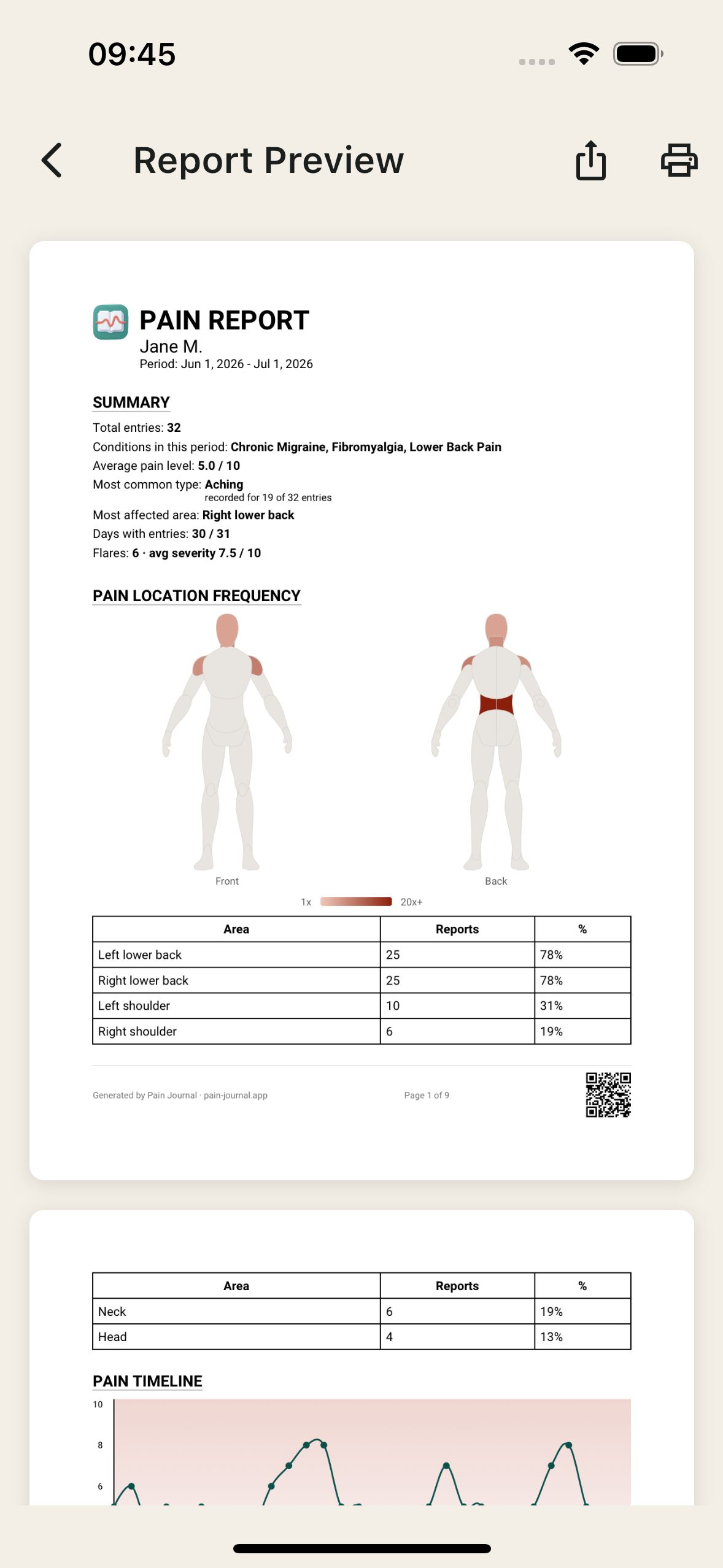
Nobody is reading four months of daily entries in a fifteen minute appointment, and a full notebook tends to get politely set aside. What works is a single summary page: how many bad days out of the total, which areas came up most, the worst-day scores, and the days you lost. The detail stays underneath for when they ask for it.
How often to log
Once a day, in seconds, ordinary days included. Marking the days that were fine is what gives you a denominator, and without one you have a pile of bad days and no idea what share of the month they were. Over a six month gap that denominator is most of the value.
The failure mode is not a missed day. It is designing an elaborate daily form in week one and abandoning it by week three, which leaves you back at remembering, now with the added irritation of having tried. A record is a sample, not an exam.
Start today
You can do all of this on paper with our free printable pain diary, which already has the 0-10 scales and the body map laid out, so the locations are a mark rather than a sentence. When the daily writing gets tedious across a long gap between appointments, Pain Journal records the same things in a few taps and builds the summary for you, free for the last 7 days, with no account.
Next: how to track rheumatoid arthritis for your doctor, or what to bring to the appointment.
Common questions
What should I track for lupus before a rheumatology appointment?
Dated entries for joint pain and where it sat, including which side, how long each bad stretch ran, what it
stopped you doing that day, and what you took or changed with the dates. Log the ordinary days too, so the
bad days have something to be counted against. Write what happened, not what you think it means.
Should I write down when I am having a flare?
Record the days and the symptoms, and let your rheumatologist decide what counts as a flare. Whether a
stretch of bad days is disease activity or something else is a clinical judgement made alongside examination
and bloods. A record of dated observations stays useful whichever way that judgement goes, while a record of
your own verdicts is harder for anyone else to read.
How do I track fatigue in a way that is actually useful?
By what it cost rather than by how it felt. A number for tiredness is hard to compare across months. A
one-line note saying you slept nine hours and still could not do the shopping, or that you went back to bed
at two in the afternoon, is concrete, dated and comparable, and it survives the question of how sure you
are.
How far back should the record go for an appointment months away?
Ideally the whole gap since the last visit, because that is exactly the period you will be asked about. If
your next appointment is sooner than that, start now anyway. Six weeks of one-line daily entries beats
reconstructing six months from memory in a fifteen minute slot.