
Psoriatic arthritis does not sit in one place. It can be a swollen finger one month, a stiff heel the next, and skin that has its own calendar. The appointment asks about all of it, and memory flattens it into "some joints".
This guide is general information about tracking symptoms and preparing for appointments, not medical advice. It does not tell you what your symptoms mean or what to do about them. Talk to your rheumatologist about your own care.
Rheumatology visits are months apart, and by the time you are in the room the stretch since the last one has shrunk to how you feel that day. The fix is not a better memory. It is a short daily record of the few things a psoriatic arthritis appointment reliably asks about: which joints, swelling, stiffness, flares, fatigue and function.
1. Which joints, and which side
"My joints hurt" is where most conversations start and it loses the most information. Name the joint and the side: left knee, right index finger, both heels. The pattern in psoriatic arthritis can be on one side only, on both, or can move between entries, and a record of sides is the only way to show that it moved.
This is where tapping a body map beats writing sentences, because the areas change from entry to entry and re-describing them in words every time is what makes people stop tracking by week three.
2. Swollen fingers and toes
A finger or toe that swells along its whole length is something a rheumatologist will ask about, and it is easy to describe while it is happening and hard to recall months later. Write which digit, which hand or foot, and the date it started. If it was gone in two days, note that too. Dates make a swelling episode something you can line up against the rest of the record.
3. Morning stiffness, in minutes
"How long does it take you to loosen up in the morning?" is asked in minutes, because minutes compare cleanly across visits. One number on waking is enough. Over a couple of months it becomes a real answer: "mostly about thirty minutes, but over an hour on six mornings, all in the same fortnight." That is a shape your rheumatologist can work with. "It varies" is not.
4. Flares, with dates on them
A flare remembered as "a rough patch sometime in the summer" cannot be lined up against anything. A flare with a start date, an end date, the joints involved and one line on what it stopped you doing can be. Three dated flares across six months is a pattern. Three remembered flares are an impression, and impressions get discounted, including by you.
5. Skin and nails, as a dated note
Psoriatic arthritis often travels with skin and nail changes, and the two are frequently looked after in separate appointments. If you have them, add a short line to the same entry: "scalp worse, right index finger swollen". You are not interpreting anything. You are making it possible to see, later, whether the two moved together. (Pain Journal has no separate skin field; it goes in the entry's note.)
6. Fatigue, on ordinary days too
Fatigue is a large part of living with an inflammatory condition for many people, and it is easy to under-report, partly because it feels like complaining and partly because it is hard to reconstruct. Give it a number of its own on paper, or a line in the note, and record it on ordinary days too, not only bad ones. Fatigue that stays high on days when your joints are quiet is a real observation, and it disappears if it only gets written down during a flare.
7. Function: what it actually stopped
Function is the part clinicians act on and the part patients leave out. Opening a jar, typing for an hour, climbing stairs, walking to the shop, getting shoes on, gripping a pen. Write the date you stopped, or the date it started costing you something. "I have not been able to open a jar with my right hand since August" is dated, specific and hard to wave away.
8. Medication timing, not medication opinions
Record what you took and when, including missed doses and days late, plus what the following days looked like on the numbers you are already recording. Keep it to what happened. Whether something is working is a question for the appointment, and it is far easier to answer there when the dates are in front of both of you.
Bring a summary, not a notebook
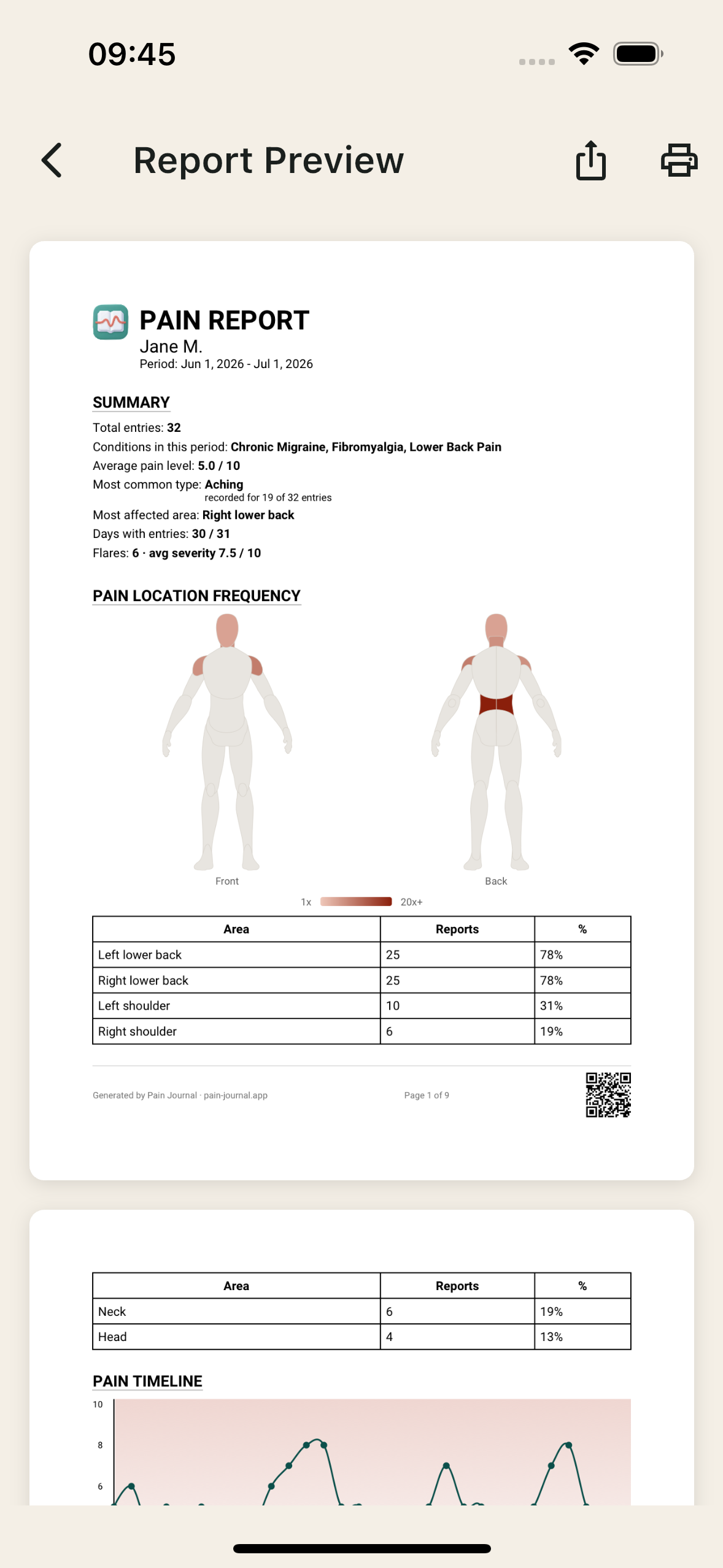
Nobody is going to read months of entries during a short appointment. What works is a summary: the joints most often involved, the stiffness range, the flare dates, the pain averages and the function line. Detail underneath for when they ask.
How often to log
Once a day, in under a minute, is enough. Missing days does not ruin anything. A record is a sample, not an exam. The failure mode is not gaps, it is designing yourself a ten minute daily ritual in week one and abandoning it by week three.
Start today
You can do all of this on paper with our free printable pain diary, which already has the body map and the 0-10 scales laid out. When the daily writing gets tedious, Pain Journal records the same things in a few taps, including sleep and the areas on a 39-zone body map, and builds the summary for you, free for the last 7 days, with no account.
Next: how to track rheumatoid arthritis for your doctor, or what to bring to the appointment.
Common questions
What should I track for psoriatic arthritis?
Which joints hurt or swell and on which side, any finger or toe that looks swollen end to end, morning stiffness in minutes, dated flares with a start and end, fatigue, and what the condition stopped you doing. Skin and nail changes are worth a dated note in the same entry, and medication timing is worth recording as dates rather than opinions about what worked.
Should I record my skin and nails as well as my joints?
If you have them, yes, as a short dated note. Psoriatic arthritis is a joint condition that often travels with skin and nail changes, and rheumatology and dermatology appointments are usually separate. A line such as "scalp worse, right index finger swollen" in the same entry lets you show how the two lined up, without interpreting it.
Why do joint side and swollen fingers or toes matter?
Which joints are involved, and whether it is one side or both, is among the first things a rheumatologist asks about and among the first things lost to memory. A finger or toe that swells along its whole length is easy to describe in the moment and hard to recall months later. One word for the side and one line for the digit is enough.
Is an app better than a notebook for tracking psoriatic arthritis?
A notebook works if you keep it up and can summarise it later. An app helps mainly with two things this condition makes tedious: marking which areas were involved when the pattern moves between joints, and producing a summary without rereading every page the night before the appointment (the free report covers the last 7 days; several-month windows are Premium).