
Osteoarthritis is slow. The knee that was fine in spring is a problem by autumn, and nothing in between feels like an event. The appointment asks how it has changed, and without a record the honest answer is "a bit worse, I think".
This guide is general information about tracking symptoms and preparing for appointments, not medical advice. It does not tell you what your symptoms mean or what to do about them. Talk to your doctor about your own care.
Because osteoarthritis changes gradually, memory is the weakest instrument you have for it. A short daily record of the few things an appointment reliably asks about turns "a bit worse, I think" into something your doctor can compare with the last visit: which joints, pain after activity and after rest, stiffness, bad days and what the pain stopped you doing.
1. Which joints, and which side
Name the joint and the side: left knee, right hip, both thumbs. Osteoarthritis often involves more than one joint, and which ones are bothering you can change over a few months. A record of sides is the only way to show that the right knee has taken over from the left.
This is where tapping a body map beats writing sentences, because the areas change from entry to entry and describing them in words every time is what makes people stop tracking by week three.
2. Pain after activity, and pain after rest
Many people notice that the pain depends on what they did before it. Some joints hurt after a long walk, others after sitting for an hour. Rate the pain from 1 to 10 once after you have been active and once after a stretch of rest, for a few weeks. You do not need to know what the pattern means. If there is one, it will show up in your own numbers, and your doctor can say what it means.
3. Morning stiffness, in minutes
"How long does it take you to loosen up in the morning?" is asked in minutes, because minutes compare cleanly across visits. One number on waking is enough. Over a couple of months it becomes a real answer: "about ten minutes most mornings, over half an hour on six of them, all in the same fortnight." "It varies" is not something anyone can compare with the last visit.
4. Bad days, with dates on them
A bad stretch remembered as "sometime in the summer" cannot be lined up against anything. A bad day with a date, the joint involved and one line on what set it off (a long walk, a day of gardening, cold weather, a poor night) can be. Three dated bad stretches across six months are a pattern. Three remembered ones are an impression, and impressions get discounted, including by you.
5. Function: what it actually stopped
Function is the part clinicians act on and the part patients leave out. Walking distance, stairs, getting out of a chair, putting on socks, opening jars, gripping a pen or a steering wheel. Write the date you stopped, or the date it started costing you something. "I have not walked to the shop without a break since August" is dated, specific and hard to wave away.
6. Sleep and the night
Pain that wakes you, or makes it hard to settle, belongs in the record next to the daytime numbers. Write whether you slept through and, if not, whether it was a particular joint. Sleep and pain pull on each other, and a few weeks of both on the same page is something to show, not something to explain from memory.
7. What you took, and when
Record what you took for the pain and when, including topical products and anything over the counter, plus how the following hours looked on the numbers you are already recording. Keep it to what happened. Whether something is working is a question for the appointment, and it is far easier to answer there when the dates are in front of both of you.
Bring a summary, not a notebook
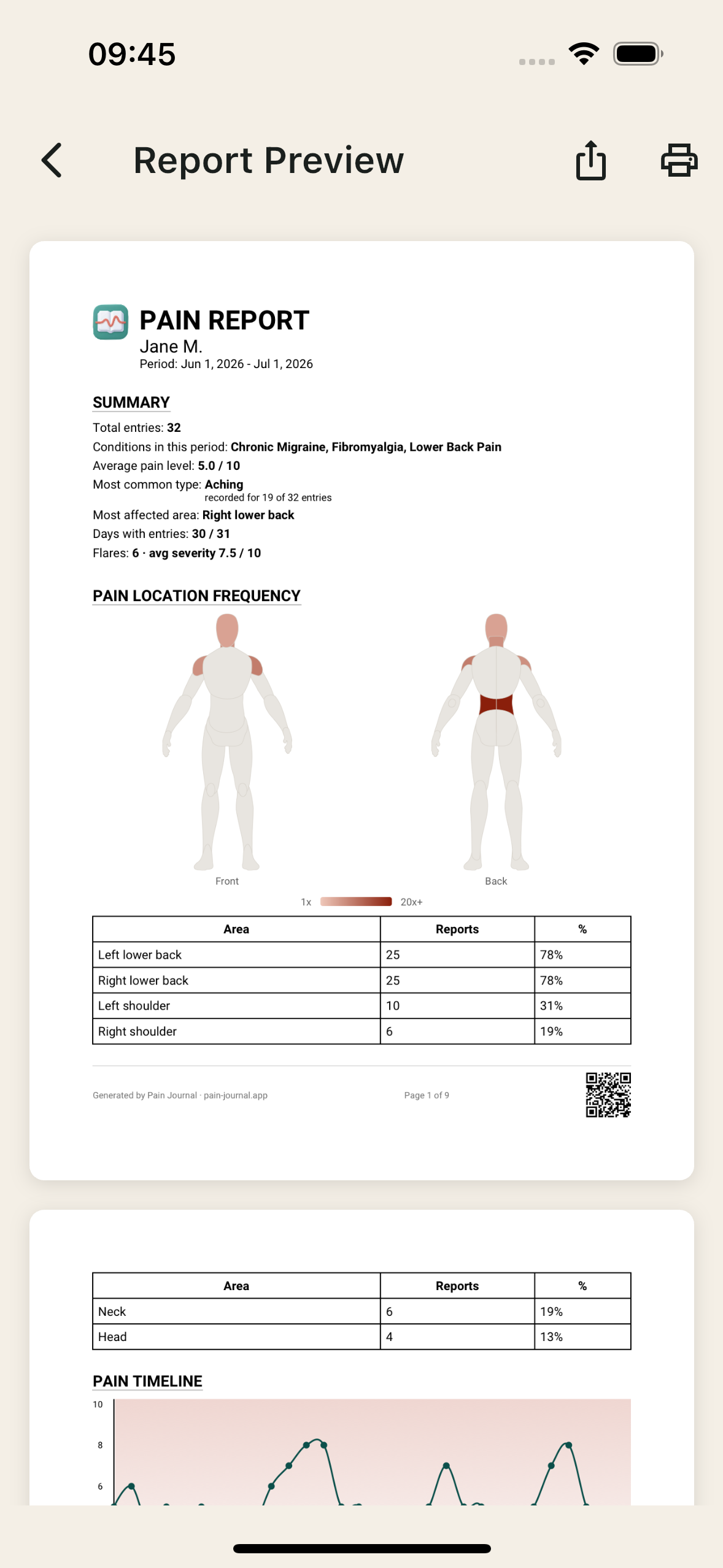
Nobody is going to read months of entries during a short appointment. What works is a summary: the joints most often involved, the stiffness range, the bad-day dates, the pain averages and the function line. Detail underneath for when they ask.
How often to log
Once a day, in under a minute, is enough. Missing days does not ruin anything. A record is a sample, not an exam. The failure mode is not gaps, it is designing yourself a ten minute daily ritual in week one and abandoning it by week three.
Start today
You can do all of this on paper with our free printable pain diary, which already has the body map and the 1 to 10 scales laid out. When the daily writing gets tedious, Pain Journal records the same things in a few taps, including sleep and the areas on a 39-zone body map, and builds the summary for you, free for the last 7 days, with no account.
Next: how to track back pain for your doctor, or what to bring to the appointment.
Common questions
What should I track for osteoarthritis?
Which joints hurt and on which side, pain from 1 to 10 after activity and again after rest, morning stiffness in minutes, the days that were clearly worse with a date on them, and what the pain stopped you doing. Walking distance, stairs and gripping are the functions an appointment asks about most.
Is osteoarthritis pain worse after activity or after rest?
It differs between people and between joints, which is the reason to write it down rather than guess. Note the pain once after you have been active and once after a stretch of rest, for a few weeks. If the two differ, that difference is a specific thing to show your doctor, who can say what it means.
Why does morning stiffness need a number in minutes?
Because minutes compare cleanly from one visit to the next. "It takes a while to loosen up" cannot be compared with anything, while "about ten minutes most mornings, over half an hour on six of them" can. One number on waking is enough.
Is an app better than a notebook for tracking osteoarthritis?
A notebook works if you keep it up and can summarise it later. An app helps with two things: marking which joints hurt when the pattern shifts between knees, hips and hands, and producing a summary without rereading every page the night before the appointment (the free report covers the last 7 days; several-month windows are Premium).