
Ask someone with long COVID how the last month went and you usually get a sentence: tired, foggy, up and down. At the appointment that sentence is all the clinician has, and the appointment itself happens on a single day that may be one of your better ones or one of your worst. A dated record turns "up and down" into something that can be read.
This guide is general information about tracking symptoms and preparing for appointments, not medical advice. It does not tell you what your symptoms mean, whether they are caused by COVID, or what to do about them. Talk to your doctor about your own care.
This page is about how to write the record, not about what it means. What follows is a shape you can keep in a notebook, in a printable sheet, or in an app, and it is small enough to survive a bad week.
1. One line a day, same shape every day
Date, a rough number for how the day went, and a few words. That is the whole entry on a bad day, and it is enough. The point is that the shape never changes, so that week three can be set next to week one.
A record you keep up beats a detailed one you drop. If you only manage the date and the number on some days, that still counts, and an honest gap is better than an entry reconstructed from memory.
2. List the symptoms that were there, not just the worst one
Long COVID rarely arrives as one symptom. Fatigue, brain fog, breathlessness, a racing heart on standing, headaches, disturbed sleep, aches, a changed sense of smell: they come in different combinations on different days. Note which were present, in your own words, and note when a new one appears for the first time.
A short checklist you repeat is easier than free writing, and it makes a symptom that quietly faded as visible as one that arrived.
3. Write what the day cost you
Scores are hard to trust when you are tired, and what the symptoms stopped you doing is easier to state and easier for a clinician to use. Worked half a day. Could not read past a page. Needed to sit down during a shower. Cancelled plans. Needed help with the stairs.
One line of function beside the number is more useful than a more precise number.
4. Record what you did, and what followed
If activity seems to be followed by a worse stretch, write the activity and the amount, and then note when you felt worse and how long it lasted. A twenty minute walk, then flat the next afternoon. Do not decide in advance what counts: mental effort, a busy shop and a long phone call belong in the same log as the walk.
Write the gap in hours or days as a fact. Whether a pattern means anything is for your clinician to judge, and you can only hand over a pattern if the pairs are written down.
5. Log the good days too
An ordinary day gets its line like any other. Those lines are the denominator: four bad days a week is a different story from four bad days a month, and "it has been a rough few months" is the sentence the record exists to replace. They also show your baseline between episodes, which is a question you will be asked and is hard to answer from inside it.
6. Note changes as dates only
A new medication, a dose change, a vaccination, another infection, a pacing routine you started, bloods, appointments, a heat wave, a return to work. Dates, not verdicts.
Resist grading whether something helped. Judging that across months with a condition that fluctuates anyway is close to impossible, and it is the conversation the appointment is for. Your job is that the dates are right.
Bring one page
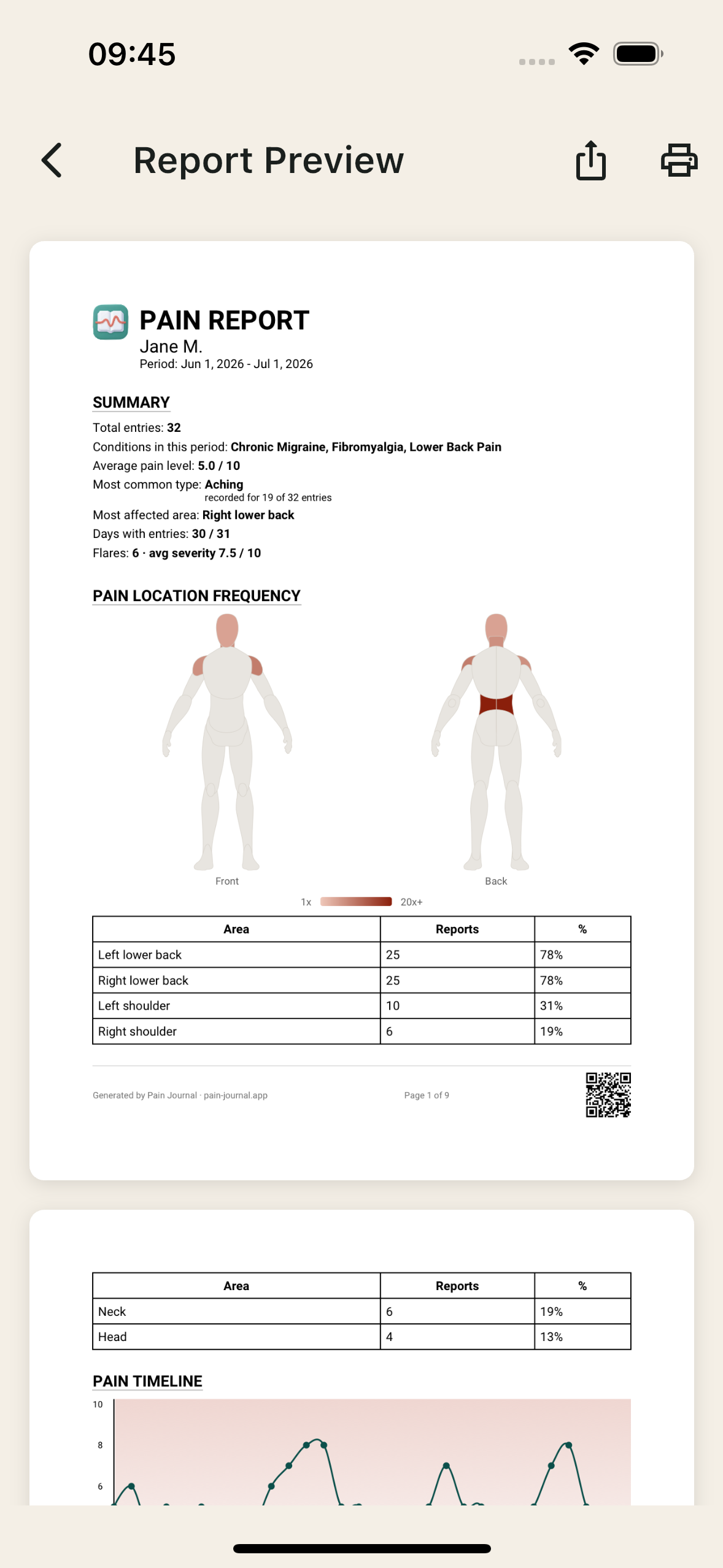
Nobody reads three months of daily entries in a short slot. What survives is a summary page: how many bad days out of the total, how long the bad stretches ran, the symptoms that came up most, the days you lost, and what changed when. The daily detail stays underneath for when they ask.
Start today
You can do all of this on paper with our free printable pain diary, which already has the daily scale and the body map laid out. When the daily writing gets tedious across a long gap between appointments, Pain Journal records the same things in a few taps and builds the summary for you, free for the last 7 days, with no account.
Next: how to track post-exertional malaise, or what to bring to the appointment.
Common questions
What should I track for long COVID before a doctor appointment?
A short entry every day: the date, a rough 1 to 10 for how the day went, which symptoms were present, what
you did and what it cost you afterwards, and any change in medication or routine. Keep it to observations,
so the clinician can see how your symptoms move over weeks instead of hearing a summary from memory.
Why log the good days as well as the bad ones?
Because long COVID fluctuates, and an appointment lands on one random day. Including the good days shows how
many days were bad, how long the bad stretches ran and what your baseline is between them. Without them you
arrive with a pile of bad days and no way to say what share of the month they were.
How do I record brain fog or fatigue when I cannot measure it?
Describe what it stopped you doing instead of scoring it precisely. Could not read for more than ten
minutes, lost the thread of a conversation, needed to lie down after a shower. A concrete line with a date
is easier to log on a bad day and easier for a clinician to use than a number you invented.
Should I write down what I think is causing my symptoms?
Write what happened and when, and leave the explanation to your clinician. Cause and diagnosis are
judgements made with examination and tests. A dated record of what you did, what you felt and how long it
lasted stays useful whichever way those judgements go.