
Most symptoms announce themselves while you are doing the thing. Post-exertional malaise does not. You go to the shops on Monday, feel roughly normal that evening, and by Tuesday night you are flat, and you stay flat into Thursday. Told out loud at an appointment, those become two separate stories: a walk, and then a bad few days. Written down with dates and hours, they are one.
This guide is general information about tracking symptoms and preparing for appointments, not medical advice. It does not tell you what your symptoms mean, whether what you experience is post-exertional malaise, or what to do about it. Talk to your doctor about your own care.
This page is about how to write the record, not about what it means. What follows is a shape you can keep in a notebook, in a printable sheet, or in an app, and it is deliberately small enough to survive a bad week.
1. The four lines that make an episode
Every episode is worth exactly four things, and one of them is the one nobody records.
What you did, and how much. Not "overdid it". A twenty minute walk. Two loads of washing. An hour of a work call. A shower and getting dressed. The amount is what makes two months of entries comparable to each other.
How many hours before you felt worse. This is the line that gets left out, and it is the one that carries the pattern. Twelve hours. Twenty-four. Two days. If you are unsure, write the range you are sure of rather than a guess dressed as a fact.
How long the worse stretch ran. In days, or in half days if that is more honest. Ending it matters as much as starting it, because a record with no end dates cannot tell anyone how long you take to come back.
What it stopped. One line. Bed until three. Missed a shift. Cancelled. Could not read. Needed help getting up the stairs.
2. Write the observation, not the label
Do not write "PEM, Tuesday to Thursday". Write what happened on Tuesday, on Wednesday and on Thursday, and let the clinician in front of you decide what to call it.
Whether a delayed crash after activity meets the definition of post-exertional malaise is a clinical judgement, and it is one of the judgements that gets revisited as a picture builds. A record made of your own verdicts has already thrown away the raw material that judgement needs. A record made of dated facts stays usable whichever way it goes, including if the answer turns out to be something else entirely.
3. Count the effort that does not look like effort
Cognitive and emotional load belongs in the same log as the walk, with the same four lines. A long concentrated stretch of work. A difficult conversation. A supermarket, with the lights and the choosing. An appointment that took three hours of travel.
Deciding in advance that only physical exertion counts filters the pattern out before anyone gets to see it. If it turns out that the crashes follow the supermarket as reliably as they follow the walk, that is worth knowing, and it is not something you would reconstruct from memory four months later.
4. Log the ordinary days as well
A day where nothing much happened and you were roughly at your usual level still gets a line. Two seconds, no detail.
Those lines are the denominator. Without them you arrive with a pile of bad days and no way to say what share of the month they were, and "it has been a bad few months" is exactly the sentence the record exists to replace. They also show what your baseline is between episodes, which is a question you will be asked and which is genuinely hard to answer from inside it.
5. Keep the scale coarse
A rough daily number is useful. A precise one is not, and chasing it is how people quit in week three.
You are not trying to detect a two-point difference between a Tuesday in March and a Tuesday in May. You are trying to make the shape of a month visible: how many days were bad, how bad the worst ones were, and what sat around them. A coarse number you actually record every day beats a careful one you abandon.
6. Note what changed, as dates only
Medication started, stopped or changed. A pacing approach you began. An infection. A vaccination. A heat wave. Bloods, appointments, anything you were told to watch for. Dates, not verdicts.
Resist grading whether something helped. Judging that from the inside, across months, with a condition that fluctuates anyway, is close to impossible, and it is the conversation you are going to the appointment to have. Your job is that the dates are right so that conversation has something to stand on.
Bring one page
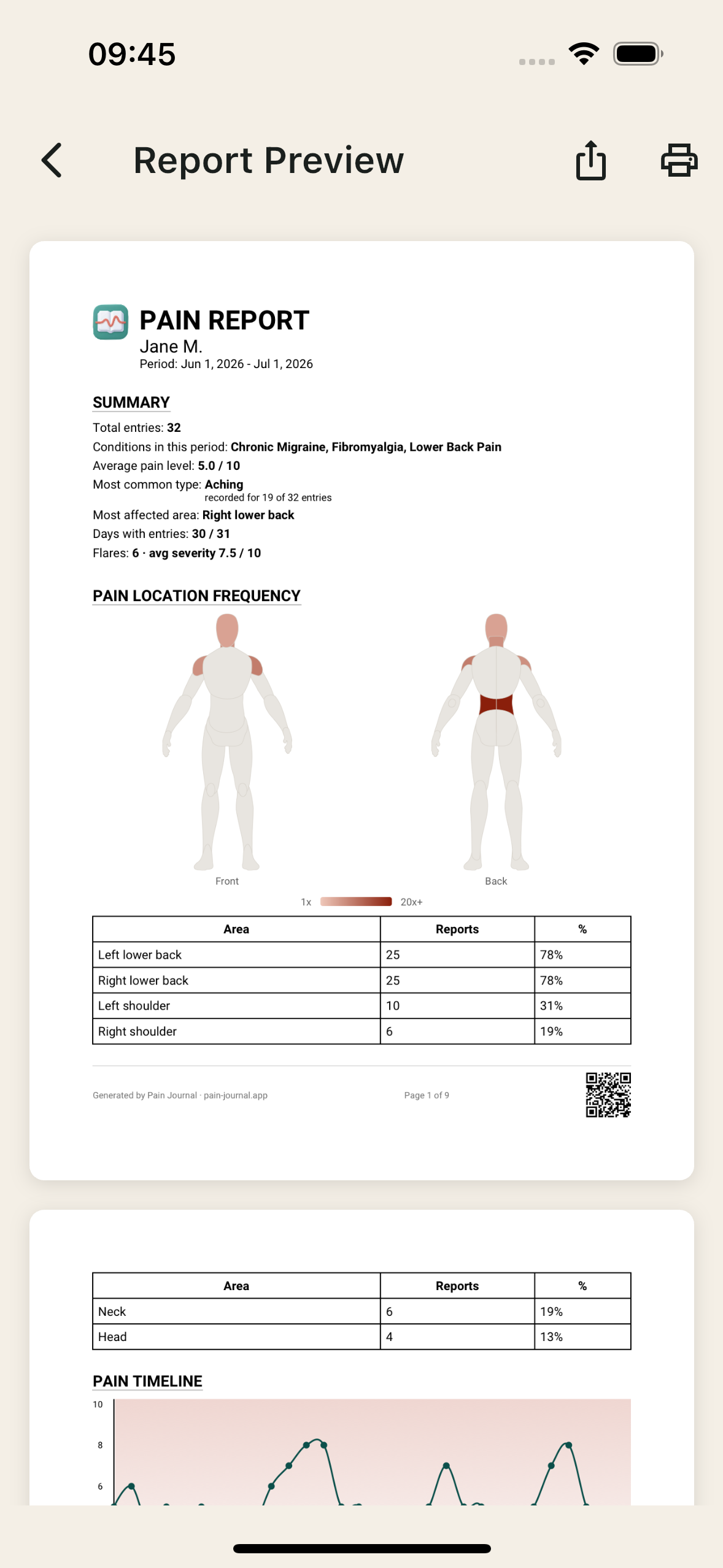
Nobody reads three months of daily entries in a fifteen minute slot, and a full notebook tends to get politely set aside. What survives is a single summary page: how many crash days out of the total, the typical delay in hours, how long episodes ran, the worst-day numbers, and the days you lost. The detail stays underneath for when they ask.
Start today
You can do all of this on paper with our free printable pain diary, which already has the daily scale and the body map laid out. When the daily writing gets tedious across a long gap between appointments, Pain Journal records the same things in a few taps and builds the summary for you, free for the last 7 days, with no account.
Next: what to write down after a flare, or what to bring to the appointment.
Common questions
What should I write down about post-exertional malaise?
Four things per episode, all dated: what you did and roughly how much of it, how many hours passed before
you felt worse, how long the worse stretch lasted, and what it stopped you doing. The gap between the
activity and the symptoms is the part that gets lost, so record it as a number of hours rather than as a
feeling.
Why does the delay matter so much?
Because a symptom that shows up during exertion reads very differently from one that shows up a day later,
and only the second is visible if the pairing is written down. Told from memory, the walk on Monday and the
three flat days that started Tuesday evening rarely arrive in the same sentence. Dated, they arrive
together.
Should I log the good days too?
Yes, and they are worth more than they look. Marking the ordinary days gives you a denominator, so four
crashes in a month is four out of thirty rather than a vague impression of a bad month. It also shows what
your baseline actually is between episodes, which is a question you will be asked.
Does mental or emotional effort count as a trigger?
Record it the same way and let your clinician decide what it means. A long phone call, a difficult
conversation, a day of concentration or a supermarket trip are all worth a line with the date and the hours
until you felt worse. Deciding in advance that only physical activity counts filters out the pattern before
anyone can see it.