
A reviewer never feels your pain. They read a file. Whether that file holds up comes down to how well your day-to-day experience was written down while it was happening, so the record is the part worth getting right.
This guide is general information about keeping a personal pain record, not medical, legal, or disability-benefits advice. It does not tell you what you qualify for or how to win a claim. For that, talk to your doctor and a disability attorney or advocate.
Chronic pain is one of the hardest things to prove on paper. It is invisible, it is self-reported, and it varies week to week, which is exactly the kind of thing a paper process struggles with. The people reviewing a claim cannot see a good day or a bad one. They can only look for a record that is consistent, detailed, and kept over a long stretch of time. That is the gap a pain diary is genuinely good at closing.
What a strong pain record contains
Whatever process you are in, the same five things make a record easy to rely on. They line up with what an assessor is trying to establish about a long-term condition:
- Entries logged in the moment. A record written while symptoms were happening reads as far more reliable than one pieced together from memory before a deadline.
- The functional limits. What the pain actually stops you doing. This is what a disability assessment turns on, more than any single score.
- How often, and how long. Flare frequency and duration, the honest count of bad days per month and how long they last, shows the pattern rather than one moment.
- An unbroken history. Many months of entries, not a snapshot. Length and continuity are what let a reviewer see the condition as ongoing.
- What you have tried. Medications, therapies, doses, and whether each helped. It shows you are actively managing the condition, and that the pain persists despite treatment.
Log in the moment, not from memory
The single biggest thing you control is consistency. A diary filled in day by day, even in a few taps, is hard to argue with. A year reconstructed the week before a review is not, and the gaps tend to make the whole period sound milder than it was. Little and often beats a marathon catch-up every time, and it is far less exhausting when you are already unwell.
Track function, not just a number
A 0 to 10 score is useful, but on its own it is easy to wave away. What lands is function stated plainly: "I cannot sit longer than twenty minutes," "I stopped driving on flare days," "I need help getting dressed when it is bad." Tie the number to the thing it takes away from you, because that thing is what the claim is actually about.
Bring it on one page
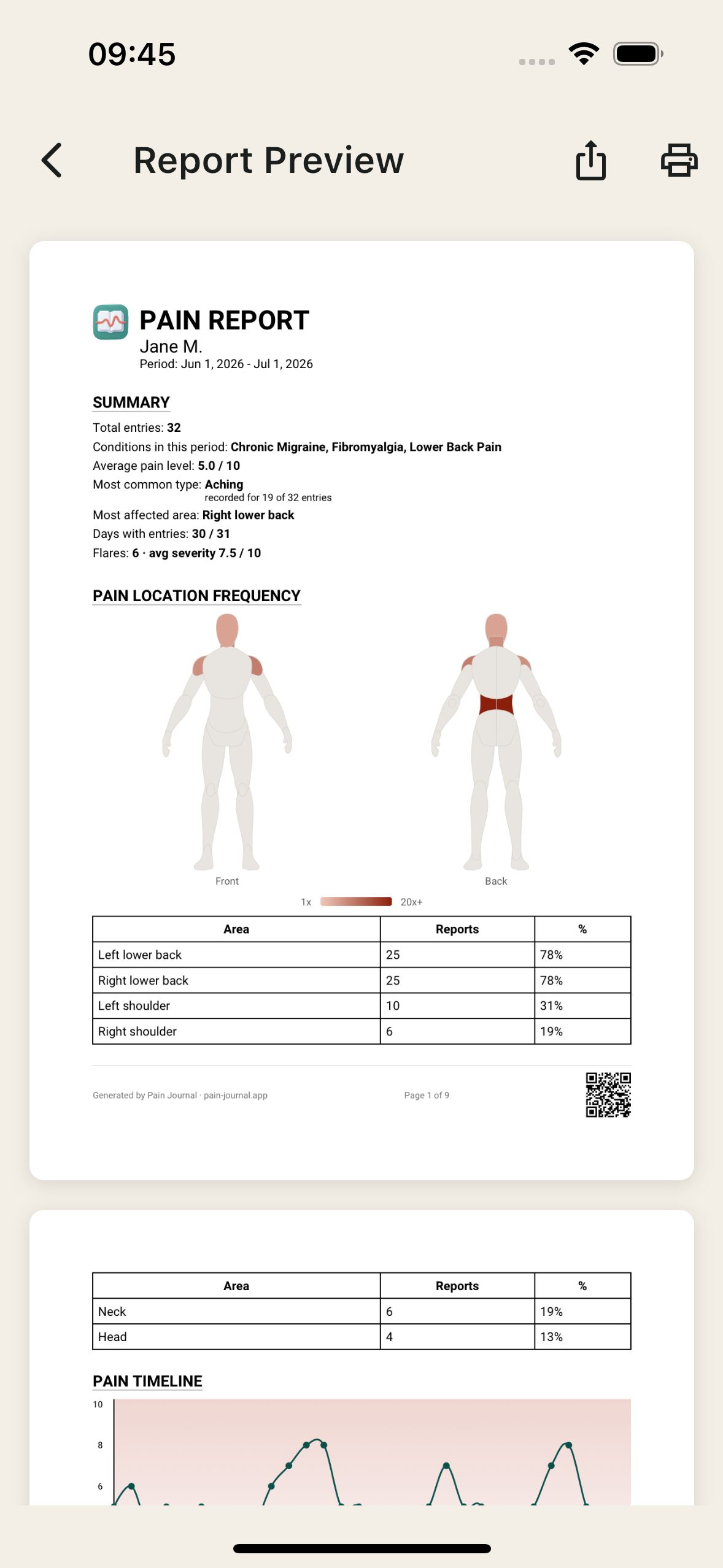
Months of entries are only useful if someone can take them in quickly. The strongest form is a single summary your doctor, and if you have one your attorney or advocate, can attach to your file: a body map of where it hurts, your worst, average, and best pain, how many flare days you logged, the main triggers, and which treatments helped. It turns scattered notes into one document that is hard to dismiss.
Start the record today
The best time to start is before you need it, because the value is in the length of the history. You can begin by hand right now with our free printable pain diary, which already lays out the body map, the scales, the trigger checklist, and space for what you tried. When filling it in by hand gets tedious, Pain Journal logs the same things in a few taps a day, keeps every entry you make so nothing is lost, and builds the summary for you. To be straight with you about where the free line falls, because this page is about length: logging is free and unlimited, and your entries are kept whether or not you ever pay. The free doctor report covers your most recent 7 days, which is what a routine appointment needs. Reading back through months of history and putting that whole span in one report is the paid part. Either way, the record you start today is still there when you need it.
Related reading: how to prove your pain to a doctor when you feel dismissed, and what to bring to a pain management appointment.
Common questions
What should a pain record for a disability claim contain?
Five things: entries logged in the moment rather than from memory, the functional limits the pain causes
(what it stops you doing), how often flares happen and how long they last, an unbroken history over many
months, and the treatments you have tried with whether each helped.
Why does contemporaneous logging matter for a claim?
A record written while symptoms were happening reads as more consistent and reliable than one reconstructed
months later. Consistency over time is what a reviewer can weigh, so logging little and often beats trying to
remember a whole year at once.
Is a pain score enough, or should I record function?
Record both, but lead with function. A disability assessment turns on what you can no longer do, so concrete
limits like cannot sit longer than twenty minutes or stopped driving on flare days carry more weight than a
number on its own.
Does keeping a pain diary decide a disability claim?
No. A diary is one piece of documentation among many, and it does not replace medical records or professional
advice. It gives your doctor and, if you use one, your attorney or advocate a clean, consistent record to
work from.
Do I need the paid version of Pain Journal for a claim?
For logging, no. Logging is free and unlimited, and every entry you make is kept regardless of whether you
ever pay. The free doctor report covers your most recent 7 days, which suits a routine appointment. A claim
usually rests on many months, and looking back across the full history and exporting that whole span in one
report is the paid part. Starting free is still worth doing today, because the entries you make now are what
a longer report is built from later.