
If you are choosing between Manage My Pain and Bearable, the useful question is not which app is better. It is what you are tracking for. One of these is built around producing something to hand to a clinician. The other is built around finding patterns in your own life. Both do their own job well, and picking the wrong one means months of daily logging that answers a question you were not asking.
This page is general information about pain-tracking apps, not medical advice. It does not tell you what your symptoms mean or what to do about them. Talk to your clinician about your own care. Feature and pricing details change, so check each app's current plans before you decide.
The short version
Manage My Pain is a long-established, pain-focused tracker organised around reporting. Its centre of gravity is the summary you produce at the end, which is why it comes up first whenever someone says "my doctor asked me to start tracking". The fuller reporting sits in a paid tier, historically a credit or subscription model, so the document is the part you pay for.
Bearable is a broad symptom and lifestyle tracker. Mood, sleep, energy, symptoms, food, factors, and it is genuinely strong at surfacing correlations across all of them. If your question is "what makes this worse", that breadth is the whole point and nothing narrower will answer it. The deeper insights and exports sit in its paid tier.
So the honest split: Manage My Pain if the appointment is the reason, Bearable if understanding your own pattern is the reason. The trap is choosing on daily-logging pleasantness and discovering six months later that you cannot produce the thing you needed.
At a glance
| What matters | Manage My Pain | Bearable | Pain Journal |
|---|---|---|---|
| Built around | Reporting pain to a clinician | Correlating pain with mood, sleep and daily factors | The doctor-visit summary, and only that |
| Doctor report | Fuller reports in the paid tier | Deeper reports and exports in the paid tier | Basic report free, always, no credits |
| Where it hurts | Pain-focused entry | Symptom lists and sliders | Front-and-back body map you tap |
| Daily effort | Moderate, pain-centred | Higher, by design, because it covers more | Tap the map, rate it, done |
| Breadth | Pain and related context | The widest of the three | Deliberately narrow |
Pricing and features across this category change often. The rows above describe what each app is organised around, not a claim about any competitor's exact present pricing. Check their current plans. All third-party names belong to their respective owners and are used here for comparison only.
Where both of them charge, and why it matters here
In this category the paid tier almost always sits on the output. Logging is free, and the document that summarises the logging is not. That is a perfectly rational way to build a business, and for a lot of people it is fine.
It stops being fine in one specific situation, which is the common one: you started tracking because a doctor asked you to, you did it faithfully for eight weeks, and the appointment is on Thursday. At that moment the report is not a premium extra. It is the entire reason the eight weeks happened. Being asked to pay at exactly that point is what sends most people looking for an alternative, and it is the single most common thread in reviews of every app in this space.
The third option, and my disclosure
I build Pain Journal, so read this section knowing that. I am not going to pretend the two apps above are bad, because they are not, and I have said what each is good at.
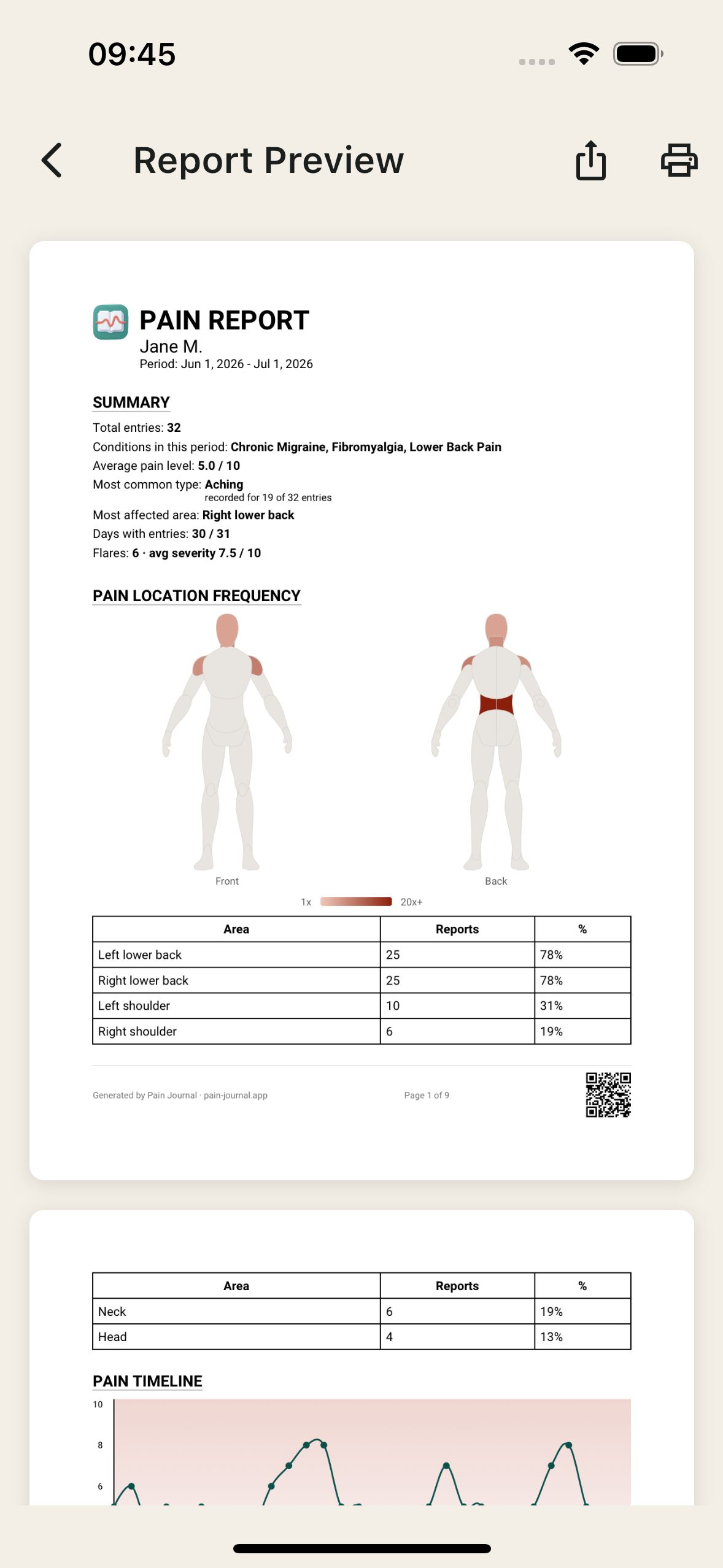
Pain Journal makes one different trade. It does less than either of them on purpose, covering pain and the handful of things that sit next to it rather than your whole life, and it keeps the doctor report free. Basic reports cover a seven day window, your last seven days or your last logged week, with no credits, no per-export fee and no subscription needed to walk out with a PDF a clinician can read. The paid tier is the heavier material: fixed thirty and ninety day windows and custom date ranges, browsing your full history inside the app, CSV export and cloud backup.
There is no account and no sign-up, and the app works offline, so entries stay on your device unless you deliberately turn backup on. If what you want is breadth and correlation, Bearable is the better tool and I would say so to your face. If what you want is a document for an appointment without paying for it, that is the case Pain Journal was built for.
How to actually decide
Answer one question honestly: at the end of three months, what do you want to be holding?
If the answer is a document that someone else has to read, pick on the strength and cost of the report and check what that report costs before you start logging, not after. If the answer is an understanding of what sets your pain off, pick on breadth and on how much daily logging you will genuinely sustain, and accept that the appointment summary is a secondary output.
And if you cannot answer it yet, that is normal, and it argues for the cheapest reversible choice. Nobody in this category imports anybody else's export, so switching later means starting the record again. Two weeks in one app tells you more than another fortnight of reading comparisons, including this one.
Start on paper first, if you like
You do not have to install anything to find out whether tracking helps you. Our free printable pain diary has the 0-10 scales and the body map already laid out, so you can run two weeks on paper, see whether the habit sticks, and only then decide which app is worth the months.
Next: a closer look at Manage My Pain alternatives, the same for Bearable, or the best free pain tracker apps for doctor visits.
Common questions
Is Manage My Pain or Bearable better for showing a doctor?
Manage My Pain is the one designed around producing a report for a clinician, so if that is your only reason
for tracking it is the closer fit of the two. Bearable is designed around correlating pain with mood, sleep,
energy and other daily factors, which is a different job and a good one, but it means the appointment-ready
summary is not what the app is organised around. Both put their fuller reporting and export behind a paid
tier, so check each app's current plans before you commit.
What is the actual difference between the two apps?
Scope. Manage My Pain is a pain-focused tracker built around reporting. Bearable is a broad symptom and
lifestyle tracker that covers mood, sleep, energy, food and factors, and is strong at surfacing correlations
across all of them. Neither is a worse app than the other. They are answering different questions, and the
right one depends on whether you are trying to explain your pain to someone else or understand it
yourself.
Do I have to pay to get a report out of a pain tracker?
In most apps the detailed report or export sits in a paid tier, whether that is a subscription or a
per-report credit. That is the normal shape of the category. It is not universal: Pain Journal keeps a basic
doctor report free with no credits and no per-export fee, and charges only for the heavier extras. Pricing
across the category changes, so check the current plans of whichever app you are considering.
Can I move my history between these apps?
Generally not directly. Pain trackers do not read each other's exports, so switching apps usually means
starting a fresh record rather than importing the old one. That is worth knowing before you pick, because
the cost of changing your mind rises with every month you log. If you are early, it costs you almost nothing
to try one for a fortnight.
If what you are really weighing is not which app but what to record in it, that is a different question and it has its own page: pain tracking vs mechanism tracking, on why a score series and a descriptive record do different jobs in an appointment.