
A general pain diary asks how much it hurt. With fibromyalgia that is half the question. The other half is how tired you were, whether sleep did anything, whether you could think straight, and whether today was a flare. Those are the parts that vanish first when you try to remember the month in a waiting room.
This page is general information about keeping a symptom record, not medical advice. Talk to your clinician about your own care.
Why fibromyalgia needs its own diary
The questions a fibromyalgia appointment covers go well past pain. The American College of Rheumatology criteria, for example, score fatigue, waking unrefreshed and trouble with thinking or memory alongside how widespread the pain is. A sheet with a single pain score and a notes box leaves most of that to memory.
The other problem is that the symptoms move. Pain shifts between areas, a good week follows a bad one, and a flare can take days to settle. Asked "how has it been?", most people describe the last few days and the worst day they can recall. A daily line turns that into a count: eleven flare days out of thirty is a finding, "quite a lot" is an impression.
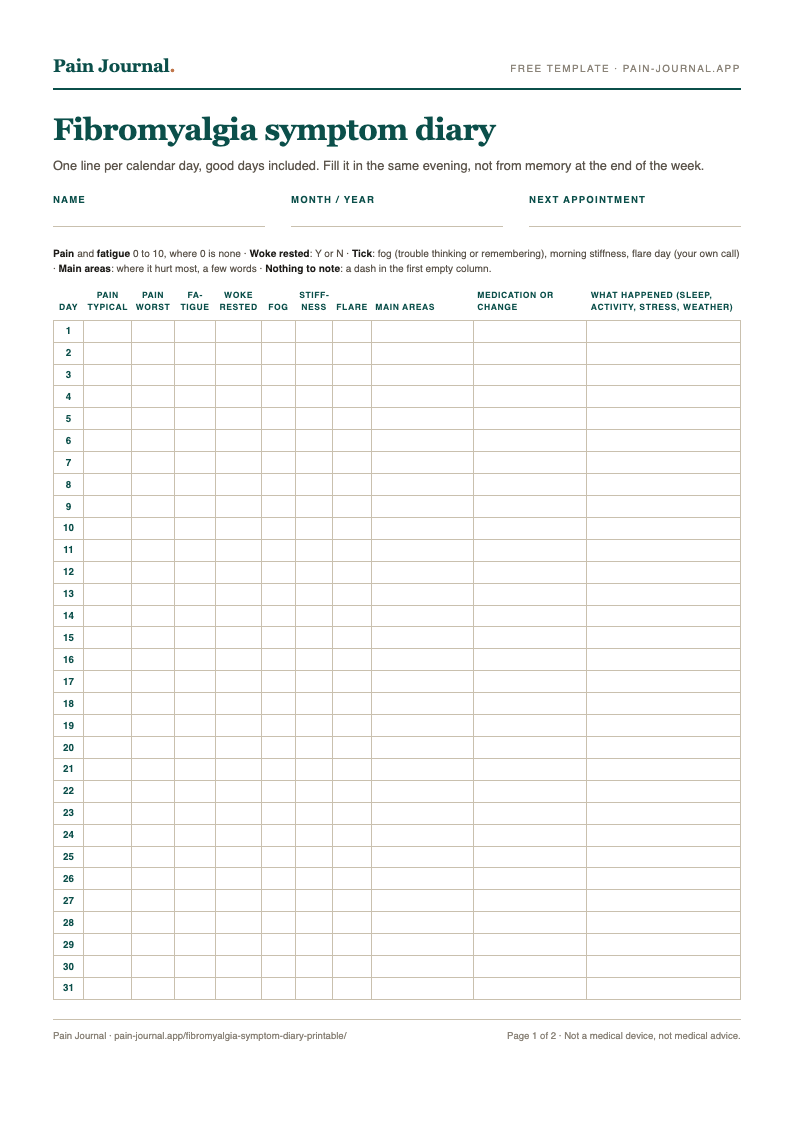
What each column is for
- Pain, typical and worst. Two numbers from 0 to 10, because a day that was mostly a 4 with one hour at 8 is not the same day as a flat 6.
- Fatigue. Its own 0 to 10, since on many fibromyalgia days it is the symptom that decides what you can do.
- Woke rested. A plain Y or N about the morning. Unrefreshing sleep is easy to report and easy to forget.
- Fog and stiffness. A tick if trouble thinking or remembering got in the way, and a tick for morning stiffness. No scale, just whether it happened.
- Flare. Your own call. What matters is that you use the same meaning all month, so the count on page two is honest.
- Main areas. A few words for where it hurt most that day. The month's pattern goes on the body map later.
- Medication or change. Anything new, stopped, missed or changed in dose, on the day it happened, so the dates line up with the rest of the row.
- What happened. Sleep, activity, stress, weather, anything unusual. Write the event, not your theory about it.
How to fill it in
Print page one at the start of the month and keep it where you will see it in the evening. Fill in one line before bed, including the good days. On a day with nothing to note, a dash in the first empty column is enough. A line takes under a minute, which is the point: a diary you can keep up on a bad day is worth more than a detailed one you abandon in week two.
Leave interpretation for later. The row records what happened; the pattern shows up when you count.
The month summary page
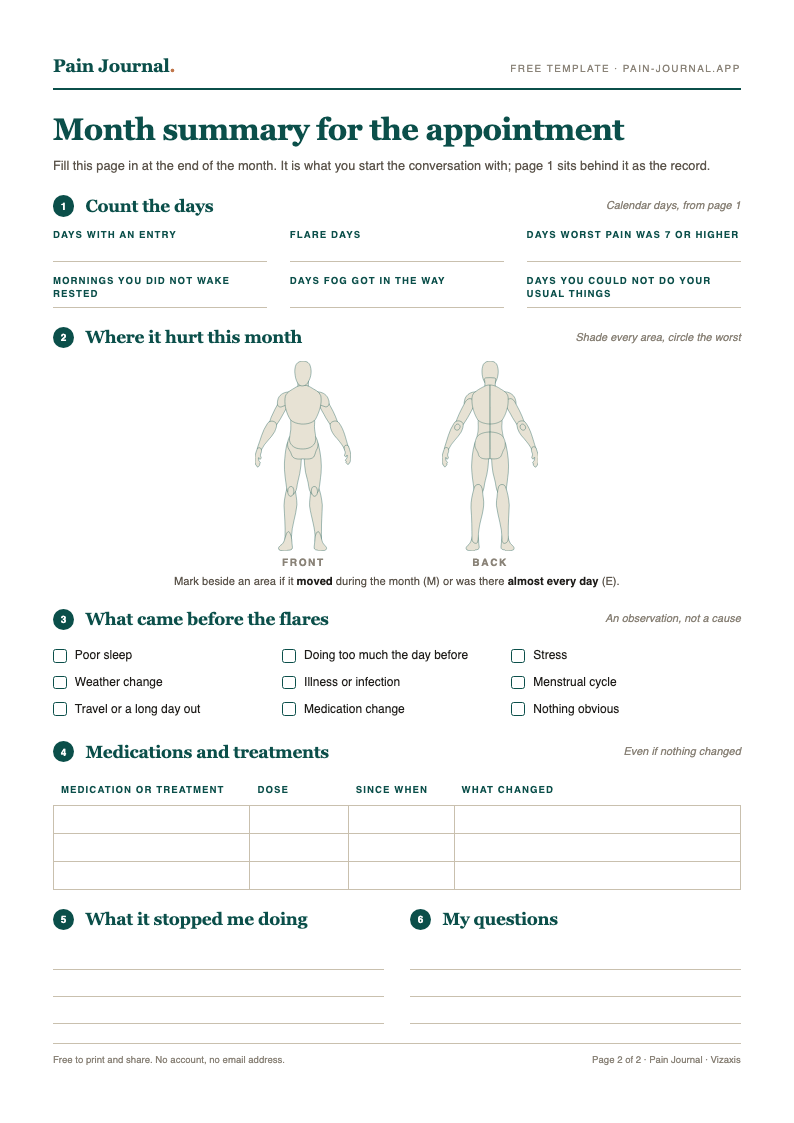
Page two is filled in once, at the end of the month, from page one. It is the part you actually talk from.
- Six counts. Days with an entry, flare days, days the worst pain reached 7 or higher, mornings you did not wake rested, days fog got in the way, and days you could not do your usual things.
- A body map. Shade every area that hurt during the month and circle the worst. Mark an M where the pain moved around and an E where it was there almost every day.
- What came before the flares. A checklist of what preceded them: poor sleep, doing too much the day before, stress, a weather change, illness, the menstrual cycle, travel, a medication change. It is an observation, not a cause.
- Medications and treatments, even the ones that did not change, with what did.
- What it stopped you doing, and your questions. The two boxes that turn a history into a plan.
Taking it to the appointment
Lead with page two. It answers the first questions in a minute and leaves the rest of a short visit for what to do next. Keep page one behind it, in case your clinician wants to see a particular week. If you can, bring two or three months, because a single month can be unusually good or unusually bad.
A written month also survives a good day. If you happen to arrive on one, the counts still carry the bad weeks into the room. For the wider question of what to track and how to summarize it, see how to track fibromyalgia for your doctor, and for the flare itself, how to track a fibromyalgia flare.
If paper gets tedious
The sheet works on its own. If redoing it every month wears thin, Pain Journal keeps a similar record on your phone: where it hurts on a body map, how much, how you slept, what came before it and what you took. It builds the doctor report as a PDF for you. The doctor report is free, covering the last 7 days, with no credits and no per-export fee; longer windows are Premium. There is no account, and it works offline.
Common questions
What should a fibromyalgia symptom diary include?
More than pain: typical and worst pain, fatigue, whether you woke rested, fog, morning stiffness, flare
days, where it hurt most, medication changes and what happened. At the end of the month, count the days,
shade a body map, and note what came before the flares.
Is this fibromyalgia diary free?
Yes, a two-page A4 PDF with no email address, no account and no sign-up. It prints on US Letter with fit to
page.
How often should I fill in a fibromyalgia diary?
Once a day, in the evening, including the good days. The count of bad days only means something next to
them.
Can a symptom diary diagnose fibromyalgia?
No. A diary records what happened; diagnosis is your clinician's job. The diary replaces estimates with
counts, so the history you give is the one you actually had.