
By the time you are back to a baseline day, the flare has already blurred. The way to keep it from disappearing is to note a few specific things in the moment, not to remember them later.
This guide is general information about tracking symptoms and preparing for appointments, not medical advice. Talk to your clinician about your own care.
Fibromyalgia rarely holds still. You get stretches that are manageable and then a flare, a run of days where the pain spreads, the fatigue deepens, and everything is harder. The problem is timing: flares fade before your next appointment, so when the doctor asks how things have been, you describe a rough average or how you feel that morning. Neither captures the flare that actually derailed your month. The fix is small and repeatable, capture the flare while you are in it.
What to capture during a flare
You do not need a diary entry. You need five quick fields, logged once when the flare is bad and again if it drags on:
- When it started, and how long. A flare that lasted five days reads very differently from an afternoon. The duration is half the story.
- Where it spread. Fibromyalgia pain moves. Marking it on a body map (front and back) shows a doctor the spread at a glance, far better than trying to list body parts from memory.
- How bad at its worst. One honest peak number beats an average. The worst point is what a clinician needs to see, and it is the part memory shrinks the most.
- What it stopped you doing. "I could not stand at the sink" or "I missed two days of work" is concrete and treatable. Function is what gets acted on.
- What came before it. The day or two ahead of the flare: sleep, stress, weather, a big exertion, a skipped dose. You are not diagnosing a cause, you are collecting the clue.
Why logging it live beats remembering
The gap between what a flare was and what you recall a week later is wide, and it almost always runs one direction, milder. We round pain down out of habit, and the worst hours are exactly the ones that blur. A ten-second note made while the flare is happening protects the detail that would otherwise be gone by the appointment.
How to find your triggers
This is where tracking pays off. One flare tells you almost nothing, any given bad day has a dozen possible causes. But log five or ten flares with the same "what came before" field, and the noise starts to cancel out. If poor sleep shows up before most of them, that is a lead worth bringing to your doctor. If nothing repeats, that is useful too, it steers the conversation away from chasing a trigger that is not there. The point is not a single answer, it is a pattern you can both look at.
Bring it on one page
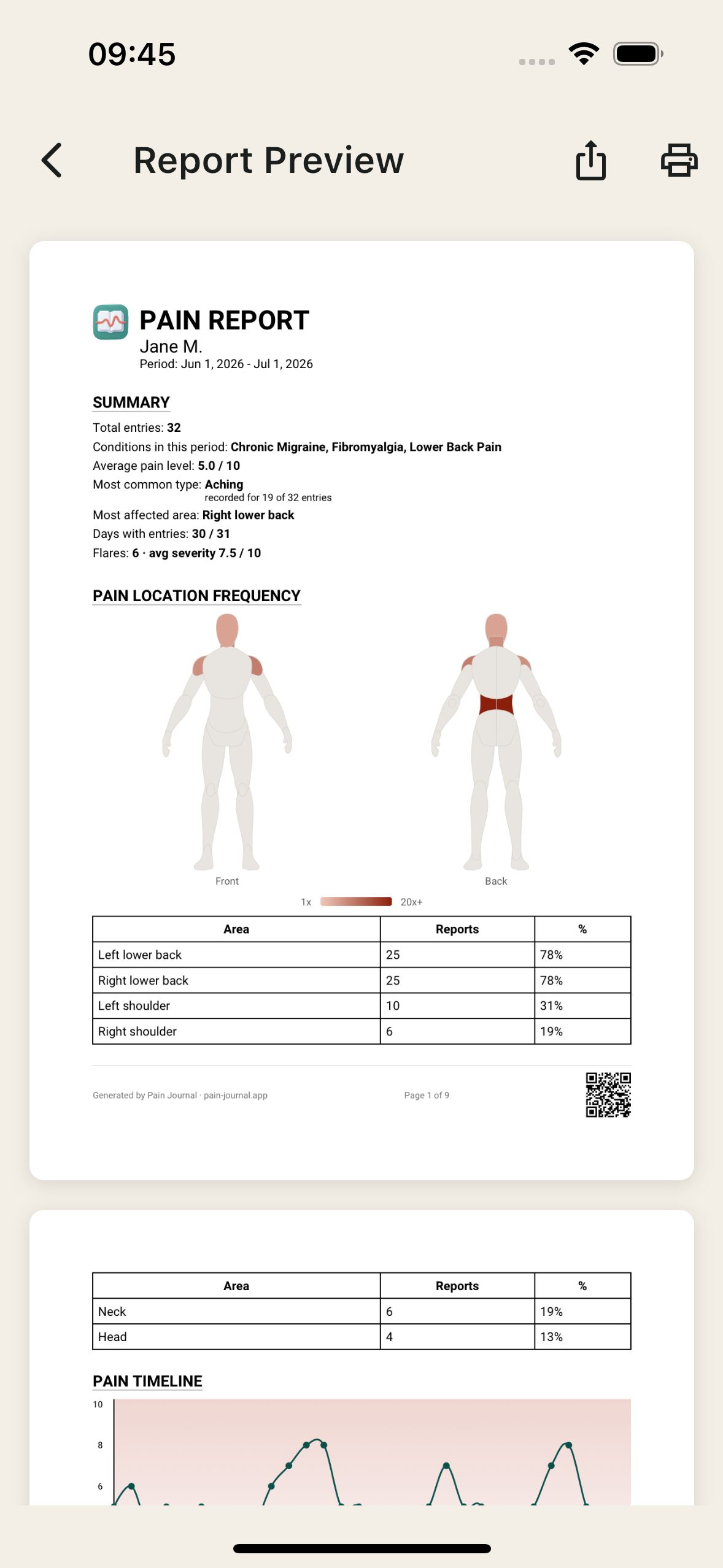
The version that changes an appointment is a single page: your flare days over the period, how severe each one got, where the pain concentrated on a body map, and the triggers that showed up most often. It turns "I have been having a lot of bad days" into a document, and a document is hard to wave away.
Start today
You can begin by hand right now with our free printable pain diary, the body map, the 0-10 scales, and the trigger checklist are already laid out, so you can note your next flare on paper. When logging by hand during a flare feels like too much, Pain Journal captures the same fields in a few taps and builds the flare-and-trigger summary for you, free.
Getting ready for an appointment? See how to track fibromyalgia for your doctor and what to tell your doctor about chronic pain.
Common questions
What should I write down during a fibromyalgia flare?
Five things: when it started and roughly how long it lasted, where the pain spread on a body map, how bad it
got at its worst, what it stopped you doing, and what happened in the day before it started (sleep, stress,
weather, overexertion, a missed dose).
How do I find what triggers my flares?
A single flare cannot tell you. Log several flares with the same fields, then look for what tends to repeat in
the day or two before them. Patterns show up across many entries, not in one bad day.
Should I track a flare even after it has passed?
Yes, note it as soon as you can. But a quick note made during the flare is more accurate than rebuilding it
later from memory, which tends to undersell how bad it was.
Can I show my flare history to my doctor?
Yes. A summary of your flare days, how severe they were, and their most common triggers is far more
useful to a clinician than saying you have been having a lot of bad days.